Advertisements
Advertisements
प्रश्न
An object is thrown vertically upwards. It rises upto a height H and then returns to its initial position. Calculate
The total distance traveled by the object
Advertisements
उत्तर
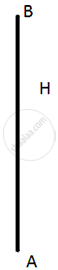
Total dist ance travelled = dist ance from A to B +distance from B to A
So total distance = H +H = 2H.
APPEARS IN
संबंधित प्रश्न
A particle is moving in a circular path of radius r. The displacement after half a circle would be :
The numerical ratio of displacement to distance for a moving object is :
What can you say about the nature of motion of a body if its displacement-time graph is A straight line inclined to the time axis with an obtuse angle?
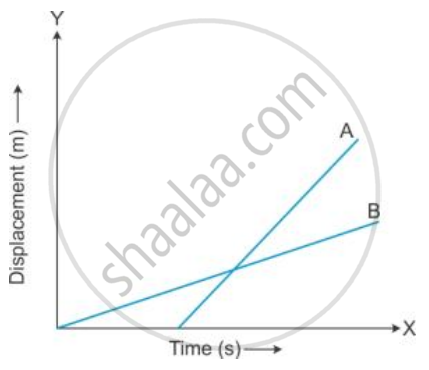
Figure shows the displacement-time graph of two vehicles A and B moving along a straight road. Which vehicle is moving faster? Give reason.
Draw a velocity-time graph for a body moving with an initial velocity u and uniform acceleration a. Use this graph to find the distance travelled by the body in time t.
Explain the following concept in your own words with everyday examples:
Distance
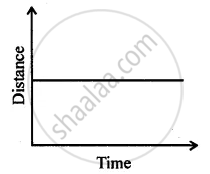
Can you suggest the kind of motion of a body from the following distance – time graph?
Write two differences between distance and displacement.
Give the name of the physical quantity that corresponds to the rate of change of displacement.
The displacement of a moving object in a given interval of time is zero. Would the distance travelled by the object also be zero? Justify your answer.
