Advertisements
Advertisements
प्रश्न
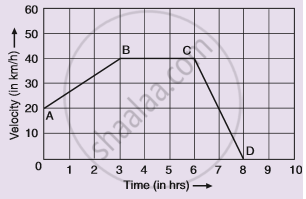
Given alongside is the velocity-time graph for a moving body :
Find :
(i) Velocity of the body at point C.
(ii) Acceleration acting on the body between A and B.
(iii) Acceleration acting on the body between B and C.
Advertisements
उत्तर
(i) BC represents uniform velocity. So velocity of the body at point C is 40 km
(ii) Acceleration = Slope of line AB
= `((40-20))/((3-0)) (km)/(hr^2)`
= 6.66 `"km/hr"^2`
(iii) BC represents uniform velocity, so, acceleration acting on the body is zero.
APPEARS IN
संबंधित प्रश्न
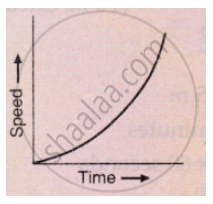
What conclusion can you draw about the acceleration of a body from the speed-time graph shown below .
Multiple choice Question. Select the correct option.
The slope of displacement – time graph represents.
A train starting from rest picks up a speed of 20 ms−1 in 200 s. It continues to move at the same rate for the next 500 s and is then brought to rest in another 100 s.
- Plot a speed-time graph.
- From graph calculate
(a) uniform rate of acceleration
(b) uniform rate of retardation
(c) total distance covered before stopping
(d) average speed.
A ball is thrown up vertically and returns back to thrower in 6 s. Assuming there is no air friction, plot a graph between velocity and time. From the graph calculate
- deceleration
- acceleration
- total distance covered by ball
- average velocity.
How does the slope of a speed-time graph give the acceleration of a body moving along a straight line?
Draw the following graph:
Speed versus time for a stepped motion
Sketch the shape of the velocity-time graph for a body moving with:
Uniformly velocity
The slope of the speed–time graph gives ______.
Mention the uses of the velocity-time graph.
From the v-t graph, ______ can be calculated.
