Advertisements
Advertisements
Question
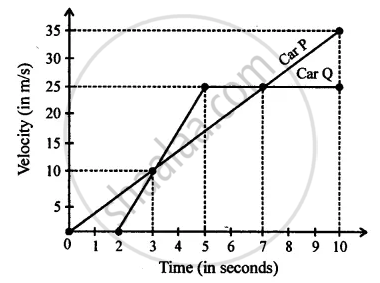
Diagram is given below shows velocity – time graph of car P and Q, starting from the same place and in the same direction. Calculate which car is ahead after 10 s and by how much?
Advertisements
Solution

Distance covered by car P = area of ΔOAB
= `1/2xx"OB"xx"AB"`
= `1/2xx10xx35`
= 175 m
Distance covered by car Q = area of ΔCDE + area of rectangle DFBE
= `1/2xx"CE"xx"DE"+"EB"xx"BF"`
= `1/2xx(5-2)xx25+(10-5)xx25`
= `75/2+125`
= 37.5 + 125
= 162.5 m
So, car P is a head of car Q by (175 − 162.5) m
i.e. by 12.5 m
APPEARS IN
RELATED QUESTIONS
What does the slope of a speed-time graph indicate ?
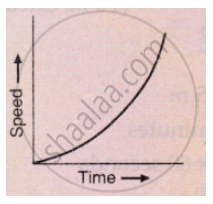
What conclusion can you draw about the acceleration of a body from the speed-time graph shown below .
What does the slope of velocity-time graph represent?
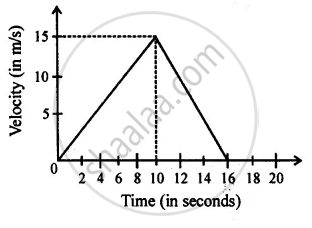
From the diagram given below, calculate distance covered by body.
What can you say about the nature of motion of a body of its displacement-time graph is:
A straight line inclined to the time axis with an acute angle?
Figure shows the distance-time graph of three students A, B and C. On the basis of the graph, answer the following :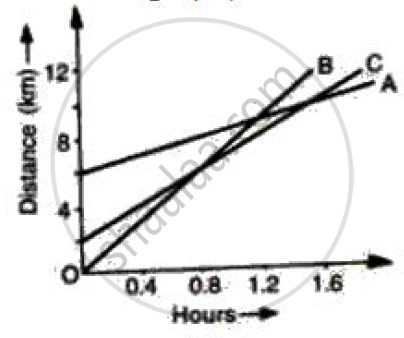
Which of the three is traveling the fastest?
State whether true or false. If false, correct the statement.
The velocity – time graph of a particle falling freely under gravity would be a straight line parallel to the x axis.
Which of the following can determine the acceleration of a moving object.
A straight line parallel to the x-axis in the velocity-time graph represents the object moving in ______.
The area of the velocity-time graph gives the displacement of the body.
