Advertisements
Advertisements
Question
A ball is thrown up vertically and returns back to thrower in 6 s. Assuming there is no air friction, plot a graph between velocity and time. From the graph calculate
- deceleration
- acceleration
- total distance covered by ball
- average velocity.
Advertisements
Solution
A ball is thrown up vertically and returns to thrower in 6s. It means the ball takes 3s to reach the highest point and 3s to reach the earth from the highest point.

For the upward motion of a ball
u = ?
v = 0
a = −g = −10 ms−2
t = 3s
v = u + at
0 = u − 10(3)
u = 30 m/s
⇒ In the graph, OA = CD = 30 m/s
(i) When the ball moves upwards, then it decelerates.
From graph, deceleration = − slope of graph AB
= `-"OA"/"OB"=-30/3` = −10 ms−2
(ii) When ball falls downwards then acceleration = Slope of v.t. graph BC
= `"CD"/"BD"=30/3` = 10 ms−2
(iii) Total distance covered = area under v.t. graph
= ar(ΔOAB) + ar(ΔBCD)
= `1/2xx"OB"xx"OA" + 1/2xx"BD"xx"CD"`
= `1/2xx30xx3+1/2xx30xx3`
= 45 + 45
= 90 m
(iv) Ball returns back to thrower in 6s.
⇒ Displacement after 6s = 0
Average velocity = `"Time distance covered"/"Total time taken"=0/6` = 0
Average speed = `"Total distance covered"/"Total time taken"=90/6` = 15 ms−1
APPEARS IN
RELATED QUESTIONS
Draw a velocity-time graph to show the following motion :
A car accelerates uniformly from rest for 5 s ; then it travels at a steady’ velocity for 5 s.
A body is moving uniformly in a straight line with a velocity of 5 m/s. Find graphically the distance covered by it in 5 seconds.
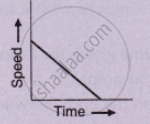
What type of motion is represented by the following graph ?
Draw displacement – time graph for the following situation:
When a body is stationary.
Draw velocity – time graph for the following situation:
When a body, is moving with uniform velocity.
Diagram shows a velocity – time graph for a car starting from rest. The graph has three sections AB, BC and CD.
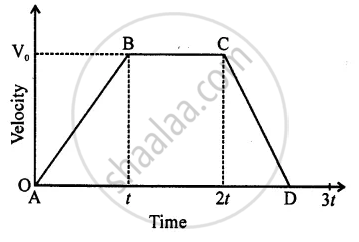
From a study of this graph, state how the distance travelled in any section is determined.
The area under a speed-time graph in a given intervals gives the total distance covered by a body irrespective of its motion being uniform or non-uniform.
The graph of one quantity versus another result in a straight line. How are the quantities related to each other?
Interpret the following graph: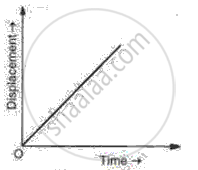
Draw distance-time graph to show:
Uniform velocity
