Advertisements
Advertisements
Question
Derive the equation
S = ut+ `1/2` at2
Using a speed- time graph
Advertisements
Solution

The area enclosed under a velocity time curve gives the distance covered by a moving body. So total distance S covered by a uniformly accelerating body is given by area of trapezium OSQP.
S = area of trapezium OSQP.
AREA of rectangle OSRP + area of triangle PRQ.
S = OP x OS + `1/2` PR xQR.
s = u x t + `1/2` x t x at
S = ut + `1/2` at2
This is known as second equation of motion.
APPEARS IN
RELATED QUESTIONS
Derive the following equation of motion by the graphical method : v2 = u2 + 2as, where the symbols have their usual meanings.
What can you say about the motion of a body if:
its displacement-time graph is a straight line ?
For uniform motion _________
From the velocity – time graph given below, calculate Distance covered in the region ABCE.
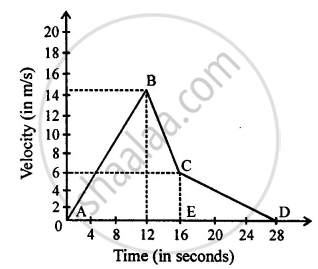
The area of the right triangle under a speed-time graph is 500 m, in a time interval of 20 s. What is the speed of the body? Is the motion uniform or non-uniform?
Draw the following graph:
Speed versus time for a uniformly retarded motion.
Draw distance-time graph to show:
Decreasing velocity
Figure shows the velocity-time graphs for two objects A and B moving in same direction . Which object has the greater a cceleration?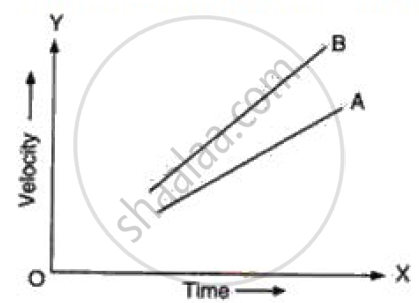
Figure shows the distance-time graph of three students A, B and C. On the basis of the graph, answer the following :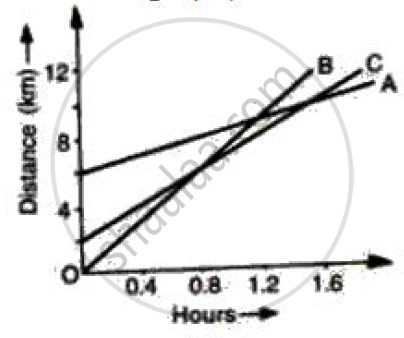
How far did B travel between the time he passed C and A?
The slope of the speed–time graph gives ______.
