Advertisements
Advertisements
प्रश्न
Derive the equation
S = ut+ `1/2` at2
Using a speed- time graph
Advertisements
उत्तर

The area enclosed under a velocity time curve gives the distance covered by a moving body. So total distance S covered by a uniformly accelerating body is given by area of trapezium OSQP.
S = area of trapezium OSQP.
AREA of rectangle OSRP + area of triangle PRQ.
S = OP x OS + `1/2` PR xQR.
s = u x t + `1/2` x t x at
S = ut + `1/2` at2
This is known as second equation of motion.
APPEARS IN
संबंधित प्रश्न
The velocity-time graph for part of a train journey is a horizontal straight line. What does this tell you about the trains velocity.
Three speed-time graphs are given below :
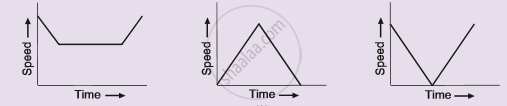
Which graph represents the case of:
(i) a cricket ball thrown vertically upwards and returning to the hands of the thrower ?
(ii) a trolley decelerating to a constant speed and then accelerating uniformly ?
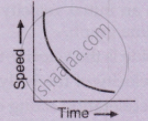
What type of motion is represented by the following graph ?
Define speed. What is its S.I. unit?
Draw a velocity-time graph for the free fall of a body under gravity starting from rest. Take g = 10m s-2
A ball is thrown up vertically and returns back to thrower in 6 s. Assuming there is no air friction, plot a graph between velocity and time. From the graph calculate
- deceleration
- acceleration
- total distance covered by ball
- average velocity.
Draw the speed-time graph of a body when its initial speed is not zero and the speed increases uniformly with time.
Interpret the following graph: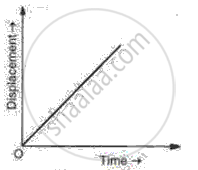
Figure shows displacement- time graph of two objects A and B moving in a stra ight line. Which object is moving fa ster?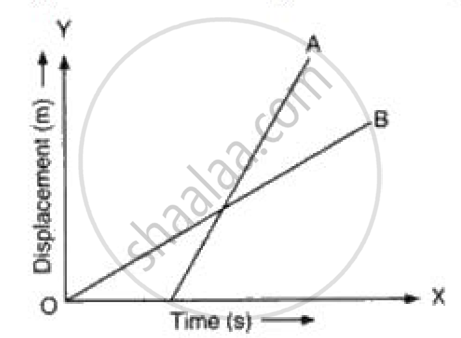
The slope of the speed–time graph gives ______.
