Figure shows the distance-time graph of three students A, B and C. On the basis of the graph, answer the following :Will the three ever meet at any point on the road?
Advertisements
Question
Figure shows the distance-time graph of three students A, B and C. On the basis of the graph, answer the following :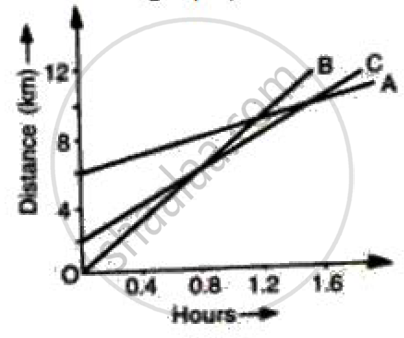
Will the three ever meet at any point on the road?
Advertisements
Solution
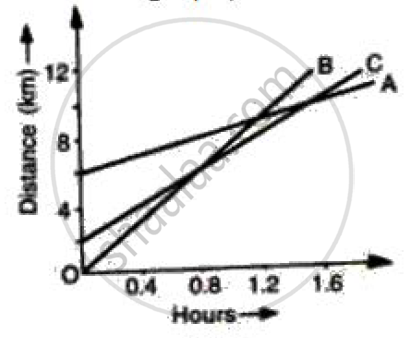
All of them never come at the same point at the same time.
APPEARS IN
RELATED QUESTIONS
What can you say about the motion of a body if:
its displacement-time graph is a straight line ?
Draw a velocity-time graph for the free fall of a body under gravity starting from rest. Take g = 10m s-2
Diagram shows a velocity – time graph for a car starting from rest. The graph has three sections AB, BC and CD.
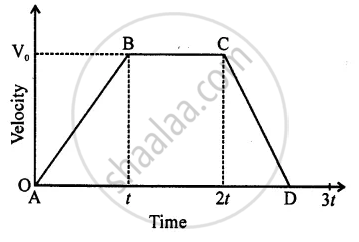
Compare the distance travelled in section BC with the distance travelled in section AB.
A train starting from rest picks up a speed of 20 ms−1 in 200 s. It continues to move at the same rate for the next 500 s and is then brought to rest in another 100 s.
- Plot a speed-time graph.
- From graph calculate
(a) uniform rate of acceleration
(b) uniform rate of retardation
(c) total distance covered before stopping
(d) average speed.
Represent the location of an object described as at 15 m, 45o west of north, on a graph paper.
Given below are the speed -time graphs. Match them with their corresponding motions :
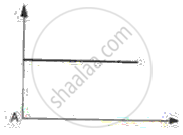 |
(a) Uniformity retared motion |
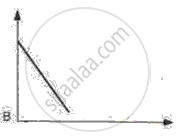 |
(b) Non-uniformity acceleration |
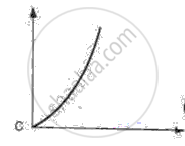 |
(c) Non-uniform motion |
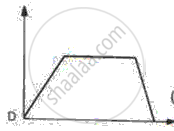 |
(d) uniform motion |
What does the slope of speed-time graph indicate?
Draw distance-time graph to show:
Uniform velocity
Interpret the following graph: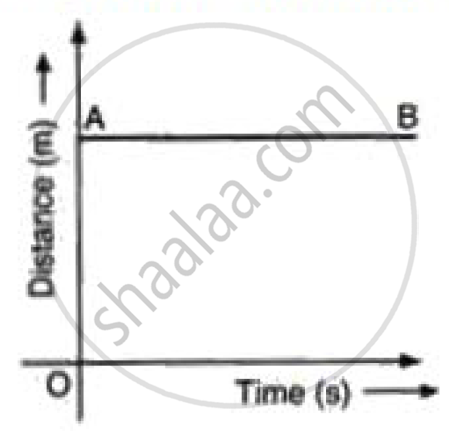
State whether true or false. If false, correct the statement.
The velocity – time graph of a particle falling freely under gravity would be a straight line parallel to the x axis.
