Advertisements
Advertisements
Question
Draw distance-time graph to show:
Uniform velocity
Advertisements
Solution

As uniform velocity means slope of line should be constant throughout the motion so this graph also represents uniform velocity
APPEARS IN
RELATED QUESTIONS
What is the quantity which is measured by the area occupied below the velocity-time graph?
Three speed-time graphs are given below :
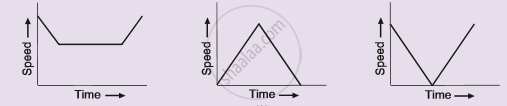
Which graph represents the case of:
(i) a cricket ball thrown vertically upwards and returning to the hands of the thrower ?
(ii) a trolley decelerating to a constant speed and then accelerating uniformly ?
Multiple choice Question. Select the correct option.
The slope of displacement – time graph represents.
Name the physical quantity which is equal to the area under speed-time graph.
Given on th e side are a few speed - time graphs for various objects moving along a stra ight line. Refer below figure. (a), (b), (c) and (d).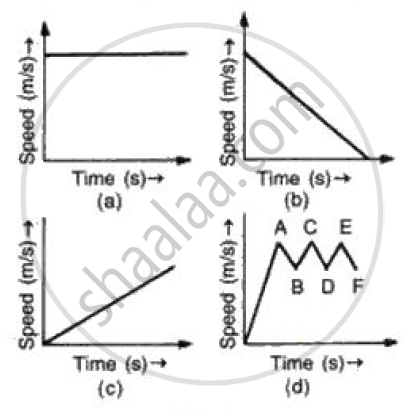
Which of these graphs represent
(a) Uni form motion
(b) Motion with speed increasing
(c) Motion with speed decreasing and
(d) Motion with speed oscillating.?
What can you conclude if the speed-time graph of a body is a straight line sloping upwards and not passing through the origin?
Draw distance-time graph to show:
Increasing velocity
Figure shows the distance-time graph of three students A, B and C. On the basis of the graph, answer the following :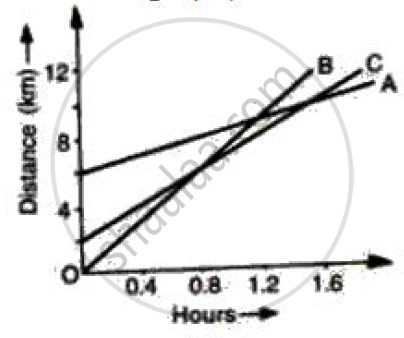
How far did B travel between the time he passed C and A?
Saphira moves at a constant speed in the same direction. Rephrase the same sentence in fewer words using concepts related to motion.
The area of the velocity-time graph gives the displacement of the body.
