Advertisements
Advertisements
Question
Name the physical quantity which is equal to the area under speed-time graph.
Advertisements
Solution
Distance is the physical quantity which is equal to the area under speed-time graph.
APPEARS IN
RELATED QUESTIONS
Three speed-time graphs are given below :
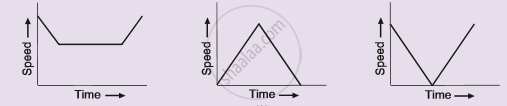
Which graph represents the case of:
(i) a cricket ball thrown vertically upwards and returning to the hands of the thrower ?
(ii) a trolley decelerating to a constant speed and then accelerating uniformly ?
A car of mass 1000 kg is moving with a velocity of 10 m s−1. If the velocity-time graph for this car is a horizontal line parallel to the time axis, then the velocity of car at the end of 25 s will be :
Define speed. What is its S.I. unit?
What does the slope of a displacement-time graph represent?
Multiple choice Question. Select the correct option.
A graph is a straight line parallel to the time axis in a distance-time graph. From the graph, it implies:
Multiple choice Question. Select the correct option.
The slope of displacement – time graph represents.
Diagram shows a velocity – time graph for a car starting from rest. The graph has three sections AB, BC, and CD.
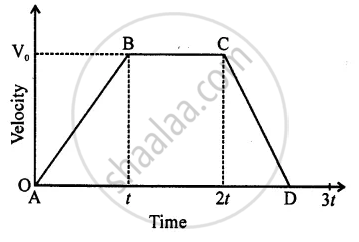
In which section, car has a zero acceleration?
A train starting from rest picks up a speed of 20 ms−1 in 200 s. It continues to move at the same rate for the next 500 s and is then brought to rest in another 100 s.
- Plot a speed-time graph.
- From graph calculate
(a) uniform rate of acceleration
(b) uniform rate of retardation
(c) total distance covered before stopping
(d) average speed.
Interpret the following graph: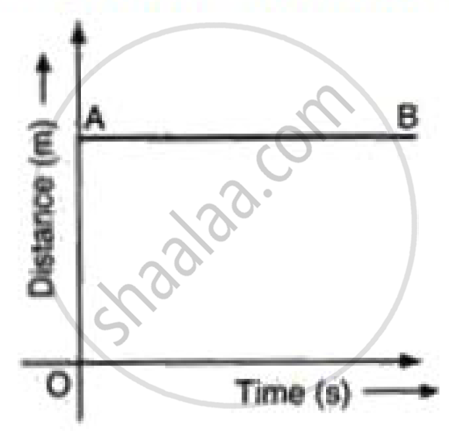
From the v-t graph, ______ can be calculated.
