Advertisements
Advertisements
Question
The velocity-time graph for part of a train journey is a horizontal straight line. What does this tell you about the trains velocity.
Advertisements
Solution
The train has a uniform velocity. This is because neither speed nor the direction of moving object is changing.
APPEARS IN
RELATED QUESTIONS
Study the speed-time graph of a car given alongside and answer the following questions:
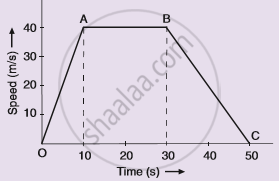
(i) What type of motion is represented by OA ?
(ii) What type of motion is represented by AB ?
(iii) What type of motion is represented by BC ?
(iv) What is the acceleration of car from O to A ?
(v)What is the acceleration of car from A to B ?
(vi) What is the retardation of car from B to C ?
What type of motion is represented by the following graph ?
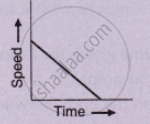
Diagram shows a velocity – time graph for a car starting from rest. The graph has three sections AB, BC and CD.
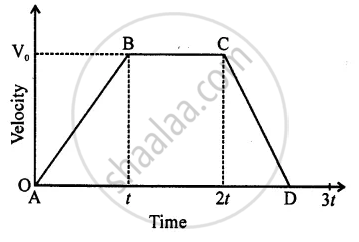
Compare the distance travelled in section BC with the distance travelled in section AB.
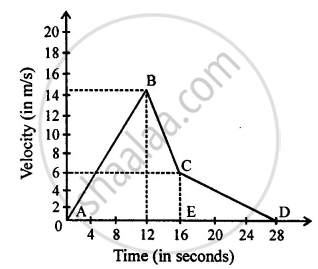
From the velocity – time graph given below, calculate acceleration in the region AB.
Represent the location of an object described as at 15 m, 45o west of north, on a graph paper.
Draw the following graph:
Speed versus time for a fluctuating speed.
What can you say about the nature of motion of a body of its displacement-time graph is:
A straight line parallel to line axis?
Derive the equation
S = ut+ `1/2` at2
Using a speed- time graph
The slope of the speed–time graph gives ______.
The velocity-displacement graph describing the motion of a bicycle is shown in the figure.

The acceleration-displacement graph of the bicycle's motion is best described by:
