Advertisements
Advertisements
Question
Study the speed-time graph of a car given alongside and answer the following questions:
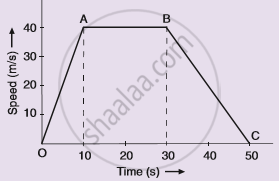
(i) What type of motion is represented by OA ?
(ii) What type of motion is represented by AB ?
(iii) What type of motion is represented by BC ?
(iv) What is the acceleration of car from O to A ?
(v)What is the acceleration of car from A to B ?
(vi) What is the retardation of car from B to C ?
Advertisements
Solution
(i) OA represents uniform acceleration
(ii) AB represents constant speed.
(iii) BC represents uniform retardation.
(iv) Acceleration of car from O to A = slope of line OA
`a = ((40-0))/((10-0))
= 4 "m/s"^2`
(v) Acceleration of car from A to B is zero as it has uniform speed .
(vi) Retardation of car from B to C = slope of line BC
`a = ((40-0))/((50-30)) "m/s"^2`
= `2 "m/s"^2`
APPEARS IN
RELATED QUESTIONS
Three speed-time graphs are given below :
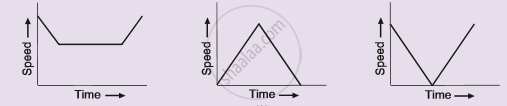
Which graph represents the case of:
(i) a cricket ball thrown vertically upwards and returning to the hands of the thrower ?
(ii) a trolley decelerating to a constant speed and then accelerating uniformly ?
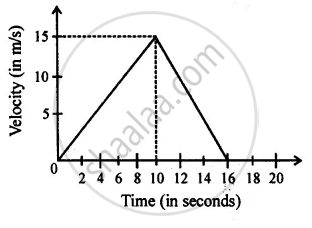
From the diagram given below, calculate distance covered by body.
Draw the following graph:
Speed versus time for a non-uniform acceleration.
Interpret the following graph: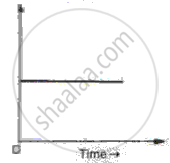
What does the slope of speed-time graph indicate?
Draw distance-time graph to show:
Decreasing velocity
What does the slope of velocity-time graph represent?
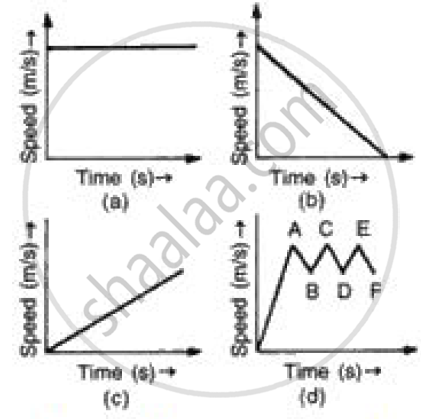
(i) In speed time graph uniform motion is given by a straight line parallel to x axis so figure (a) denotes the uniform motion.
(ii) In speed time graph motion with increasing speed is shown by straight line with positive slope so figure (c) denotes the motion with speed increasing.
(iii) In speed time graph motion with decreasing speed is shown by straight line with negative slope so figure (b) denotes the motion with speed decreasing.
(iv) In speed time graph motion with oscillating speed is shown by zigzag line so figure {d) denotes the motion with speed oscillating.
State whether true or false. If false, correct the statement.
The velocity – time graph of a particle falling freely under gravity would be a straight line parallel to the x axis.
The area of the velocity-time graph gives the displacement of the body.
