Advertisements
Advertisements
Question
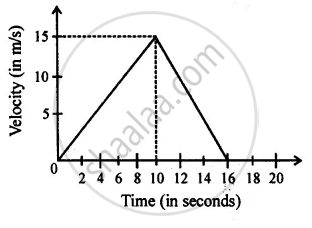
From the diagram given below, calculate distance covered by body.
Advertisements
Solution

Distance covered = area under v.t. graph
= area of ΔOAC + area of ΔABC
= `1/2xx"OC"xx"AC"+1/2xx"BC"xx"AC"`
= `1/2xx10xx15+1/2xx6xx15`
= 5 × 15 + 3 × 15
= 75 + 45
= 120 m
APPEARS IN
RELATED QUESTIONS
Name the two quantities, the slope of whose graph give acceleration.
The velocity-time graph for part of a train journey is a horizontal straight line. What does this tell you about the trains velocity.
Draw a displacement-time graph for a boy going to school with uniform velocity.
Draw displacement – time graph for the following situation:
When a body is stationary.
What can you conclude if the speed-time graph of a body is a curve moving upwards starting from the origin?
What can you conclude if the speed-time graph of a body is a straight line sloping upwards and not passing through the origin?
Draw the following graph:
Speed versus time for a stepped motion
Figure shows the velocity-time graphs for two objects A and B moving in same direction . Which object has the greater a cceleration?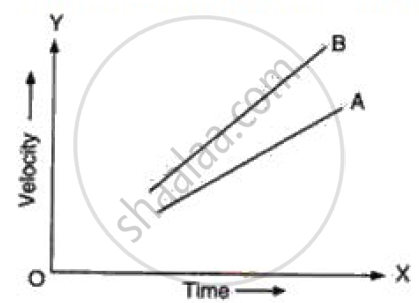
Saphira moves at a constant speed in the same direction. Rephrase the same sentence in fewer words using concepts related to motion.
A straight line parallel to the x-axis in the velocity-time graph represents the object moving in ______.
