Advertisements
Advertisements
Question
The area under a speed-time graph in a given intervals gives the total distance covered by a body irrespective of its motion being uniform or non-uniform.
Advertisements
Solution
Yes area under a speed time graph in a given interval gives the total distance covered by a body.
APPEARS IN
RELATED QUESTIONS
Show by means of graphical method that: v = u + at, where the symbols have their usual meanings.
Diagram shows a velocity – time graph for a car starting from rest. The graph has three sections AB, BC and CD.
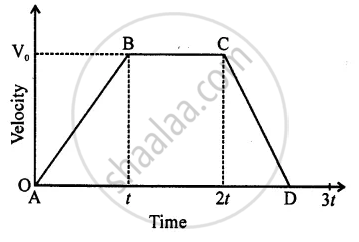
Compare the distance travelled in section BC with the distance travelled in section AB.
Name the physical quantity which is equal to the area under speed-time graph.
Figure shows the distance-time graph of three students A, B and C. On the basis of the graph, answer the following :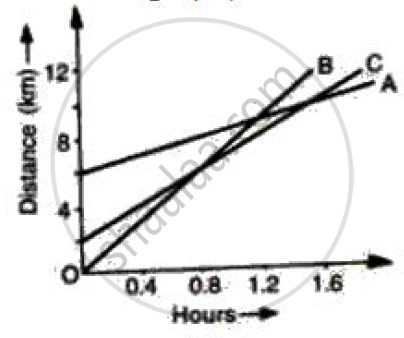
How far did B travel between the time he passed C and A?
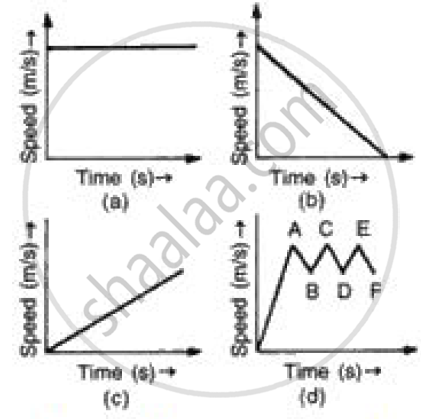
(i) In speed time graph uniform motion is given by a straight line parallel to x axis so figure (a) denotes the uniform motion.
(ii) In speed time graph motion with increasing speed is shown by straight line with positive slope so figure (c) denotes the motion with speed increasing.
(iii) In speed time graph motion with decreasing speed is shown by straight line with negative slope so figure (b) denotes the motion with speed decreasing.
(iv) In speed time graph motion with oscillating speed is shown by zigzag line so figure {d) denotes the motion with speed oscillating.
Saphira moves at a constant speed in the same direction. Rephrase the same sentence in fewer words using concepts related to motion.
Mention the uses of the velocity-time graph.
A straight line parallel to the x-axis in the velocity-time graph represents the object moving in ______.
The area of the velocity-time graph gives the displacement of the body.
An object is moving in a positive direction with positive acceleration. The velocity-time graph with constant acceleration which represents the above situation is:
