Advertisements
Advertisements
Question
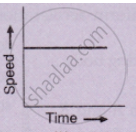
What type of motion is represented by the following graph ?
Advertisements
Solution
Graph (b) represents a motion of constant speed.
APPEARS IN
RELATED QUESTIONS
For uniform motion _________
Multiple choice Question. Select the correct option.
A graph is a straight line parallel to the time axis in a distance-time graph. From the graph, it implies:
A ball is thrown up vertically and returns back to thrower in 6 s. Assuming there is no air friction, plot a graph between velocity and time. From the graph calculate
- deceleration
- acceleration
- total distance covered by ball
- average velocity.
From the diagram given below, calculate distance covered by body.
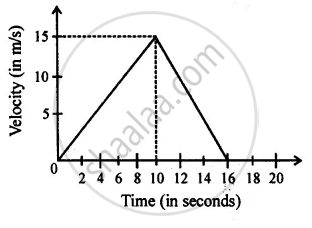
The area under a speed-time graph in a given intervals gives the total distance covered by a body irrespective of its motion being uniform or non-uniform.
Draw the following graph:
Speed versus time for a stepped motion
Draw the following graph:
Distance versus time for a body at rest.
Draw the following graph:
Speed versus time for a fluctuating speed.
What can you say about the motion of a body if:
Its time-velocity graph is a straight line
The area under the v-t graph represents a physical quantity that has the unit.
