Advertisements
Advertisements
Question
A body at rest is thrown downward from the top of the tower. Draw a distance – time graph of its free fall under gravity during the first 3 seconds. Show your table of values starting t = 0 with an interval of 1 second, (g = 10 ms−2).
Advertisements
Solution
Initial velocity = M = 0
Acceleration = a = +g = 10 ms−2
when t = Is, then distance travelled (S), is given by
S1 = ut + `1/2` at2
S1 = `0(1)+1/2(10)(1)^2`
S1 = 5m
When t = 2s then S2 = ut + `1/2` at2
S2 = `(0)(2)+1/2(10)(2)^2`
S2 = 5(4) = 20 m
When t = 3s, then S3 = ut + `1/2` at2
S3 = `(0)(3)+1/2(10)(3)^2`
S = 5 (9) = 45 m
| Time | 1s | 2s | 3s |
| Distance covered | 5 m | 20 m | 45 m |

APPEARS IN
RELATED QUESTIONS
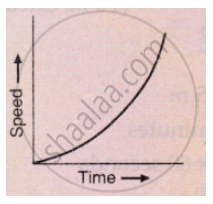
What conclusion can you draw about the acceleration of a body from the speed-time graph shown below .
What can you say about the motion of a body if:
its velocity-time graph is a straight line ?
The speed-time graph of an ascending passenger lift is given alongside. What is the acceleration of the lift:
(1) during the first two seconds ?
(2) between second and tenth second ?
(3) during the last two seconds ?
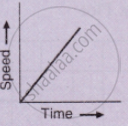
What type of motion is represented by the following graph ?
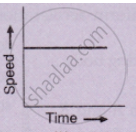
What type of motion is represented by the following graph ?
Draw a velocity-time graph for the free fall of a body under gravity starting from rest. Take g = 10m s-2
Draw velocity – time graph for the following situation:
When a body, is moving with uniform velocity.
Draw velocity-time graph to show:
Acceleration
Write a sentence to explain the shape of graph.
Interpret the following graph: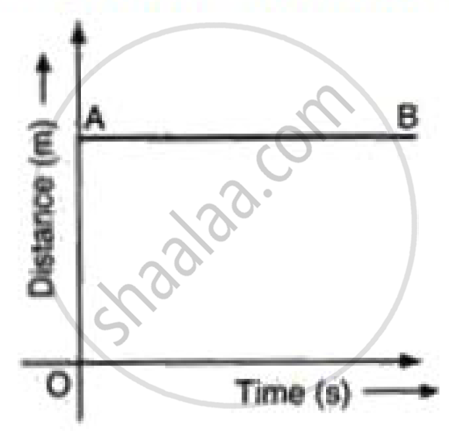
From the v-t graph, ______ can be calculated.
