Advertisements
Advertisements
Question
Show by means of graphical method that: v = u + at, where the symbols have their usual meanings.
Advertisements
Solution
Consider the velocity-time graph of a body shown in figure.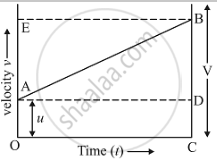
The body has an initial velocity (u) at a point A and then, its velocity changes at a uniform rate from A to B in time, (t). In other words, there is a uniform acceleration (a) from A to B, and after time (t) its final velocity becomes (v) which is equal to BC in the graph. The time (t) is represented by OC. To complete the figure, we draw the perpendicular CB from point C, and draw AD parallel to OC. BE is the perpendicular from point B to OE.
And, final velocity of the body, (v) = BC …… (2)
But from the graph BC = BD + DC
Therefore, v = BD + DC ……(3)
Again DC = OA
So, v = BD + OA
Now, from equation (1),
So, v = BD + u ......(4)
We should find out the value of the slope of a velocity-time graph which is equal to the acceleration,
Thus, Acceleration,
`a = "BD"/"AD"`
But AD = OC = t, so putting t in place of AD in the above relation, we get,
`a = "BD"/t`
So, BD = at
Now, putting this value of BD in equation (4), we get the 1st equation of motion-:
`v = u + at`
where,
(a) - Acceleration
(v) - Final velocity
(u) - Initial velocity
(t) - Time taken
APPEARS IN
RELATED QUESTIONS
A body is moving uniformly in a straight line with a velocity of 5 m/s. Find graphically the distance covered by it in 5 seconds.
Multiple choice Question. Select the correct option.
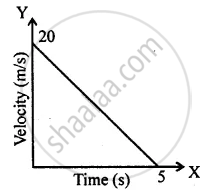
The distance covered in the adjoining velocity-time graph is :
Draw displacement – time graph for the following situation:
When a body is stationary.
A ball is thrown up vertically and returns back to thrower in 6 s. Assuming there is no air friction, plot a graph between velocity and time. From the graph calculate
- deceleration
- acceleration
- total distance covered by ball
- average velocity.
Name the physical quantity which is equal to the area under speed-time graph.
The graph of one quantity versus another result in a straight line. How are the quantities related to each other?
Draw the speed-time graph of a body when its initial speed is not zero and the speed increases uniformly with time.
Figure shows the velocity-time graphs for two objects A and B moving in same direction . Which object has the greater a cceleration?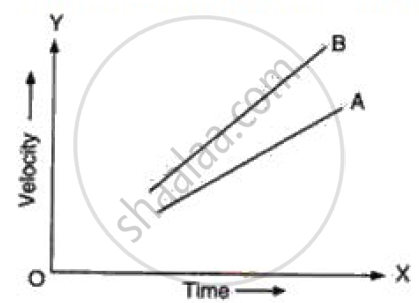
Sketch the shape of the velocity-time graph for a body moving with:
Uniformly velocity
Figure shows the distance-time graph of three students A, B and C. On the basis of the graph, answer the following :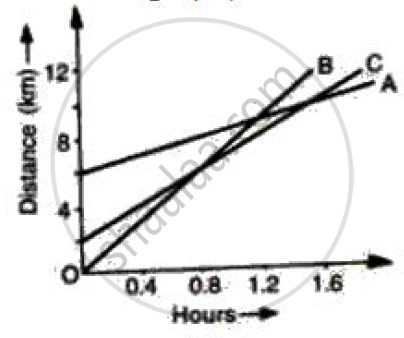
How far did B travel between the time he passed C and A?
