Advertisements
Advertisements
Question
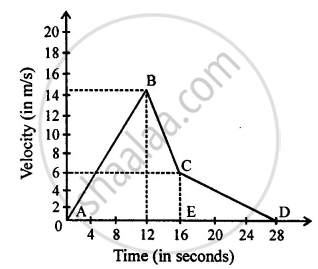
From the velocity – time graph given below, calculate Distance covered in the region ABCE.
Advertisements
Solution
Distance covered in region ABCE = ar(ΔABF) + area of trapezium BCEF
= `1/2xx"AF"xx"BF"+1/2("BF+CF")xx"GC"`
= `1/2xx12xx14+1/2(14+6)xx4`
= 6 × 14 + 10 × 4
= 84 + 40
= 124 m
APPEARS IN
RELATED QUESTIONS
What is the quantity which is measured by the area occupied below the velocity-time graph?
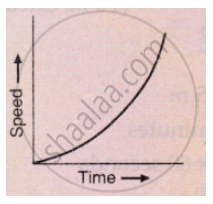
What conclusion can you draw about the acceleration of a body from the speed-time graph shown below .
A body with an initial velocity x moves with a uniform acceleration y. Plot its velocity-time graph.
Study the speed-time graph of a car given alongside and answer the following questions:
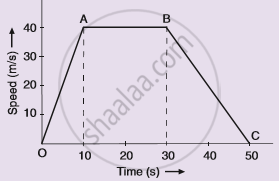
(i) What type of motion is represented by OA ?
(ii) What type of motion is represented by AB ?
(iii) What type of motion is represented by BC ?
(iv) What is the acceleration of car from O to A ?
(v)What is the acceleration of car from A to B ?
(vi) What is the retardation of car from B to C ?
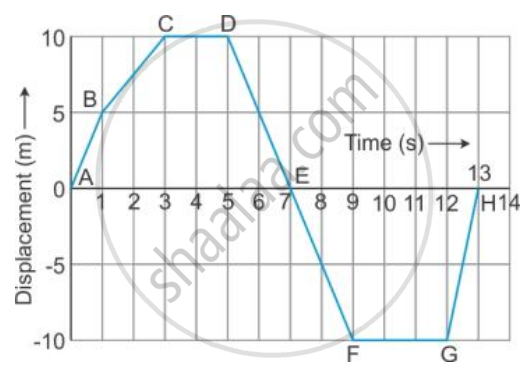
From the displacement-time graph of a cyclist given below in the Figure, find The time after which he reaches the starting point .
Draw the following graph:
Speed versus time for a uniformly retarded motion.
Which of the following graphs represents a motion with negative acceleration?
Draw velocity-time graph to show:
Acceleration
Write a sentence to explain the shape of graph.
Draw velocity-time graph to show:
Deceleration
Write a sentence to explain the shape of graph.
The area under the v-t graph represents a physical quantity that has the unit.
