Advertisements
Advertisements
प्रश्न
A cheetah starts from, rest, and accelerates at 2 m/s2 for 10 seconds. Calculate :
(a) the final velocity
(b) the distance travelled.
Advertisements
उत्तर
We have to find the distance travelled by the cheetah. We have the following information given,
So, initial velocity, (u) = 0 m/s
Acceleration, (a) = 2 m/s2
Time taken, (t) = 10 s
(a) So, we can find the final velocity using the relation, v = u + at
Final velocity,
v = 0 + (2) (10)
= 20 m/s
(b) We can calculate the distance travelled by cheetah using the 2nd equation of motion,
`s = ut + 1/2 at^2`
Put the values in above equation to find the distance travelled
`(s) = 0(10) + 1/2(2)(10)^2`
= 100 m
APPEARS IN
संबंधित प्रश्न
When will you say a body is at non-uniform acceleration?
Name the physical quantity whose SI unit is :
(a) m/s (b) m/s2
What conclusion can you draw about the velocity of a body from the displacement-time graph shown below :
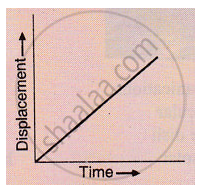
Find the initial velocity of a car which is stopped in 10 seconds by applying brakes. The retardation due to brakes is 2.5 m/s2.
A bus running at a speed of 18 km/h is stopped in 2.5 seconds by applying brakes. Calculate the retardation produced.
Derive the formula : v = u + at, where the symbols have usual meanings.
The slope of a speed-time graph gives:
A car starting from rest acquires a velocity 180m s-1 in 0.05 h. Find the acceleration.
A packet is dropped from a stationary helicopter, hovering at a height ‘h’ from ground level, reaches the ground in 12s. Calculate
- the value of h
- final velocity of packet on reaching the ground. (Take g = 9.8 ms−2)
How will the equations of motion for an object moving with a uniform velocity change?
