Advertisements
Advertisements
Question
A car starts from rest and it is travelling with a velocity of 20 m/s in 10 s. What is its acceleration?
Advertisements
Solution
Given :
Initial velocity of the car (u) = 0 m/s
Final velocity of the car (v) = 20 m/s
time taken = 10s
Acceleration = ?
Formula:
Acceleration = \(\frac {20– 0}{10}\) = \(\frac {20}{10}\)
Acceleration of the car = 2 m/s2
APPEARS IN
RELATED QUESTIONS
State the type of motion represented by the following sketches in Figures.
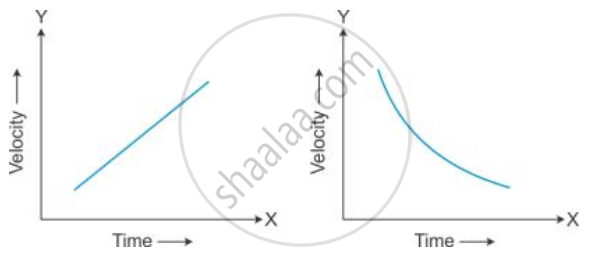
Give an example of each type of motion.
Draw a graph for acceleration against time for a uniformly accelerated motion. How can it be used to find the change in speed in a certain interval of time?
A bullet initially moving with a velocity 20 m/s strikes a target and comes to rest after penetrating a distance 10 cm into the target. Calculate the retardation caused by the target.
A train moving with a velocity of 20 ms−1 is brought to rest by applying brakes in 5 s. Calculate the retardation.
State its value in C.G.S. as well as in S.I. system.
A car traveling at 60 km/h, stops on applying brakes in 10 seconds. What is its acceleration?
The speed of a car increases from 10 km/h to 64 km/h in 10 seconds. What will be its acceleration?
State if the following situation is possible:
A body moving with a constant velocity in an accelerated motion.
Sketch the shape of the velocity-time graph for a body moving with:
Uniform acceleration.
The graph shows how the velocity of a scooter varies with time in 50 s.
Work out: Acceleration.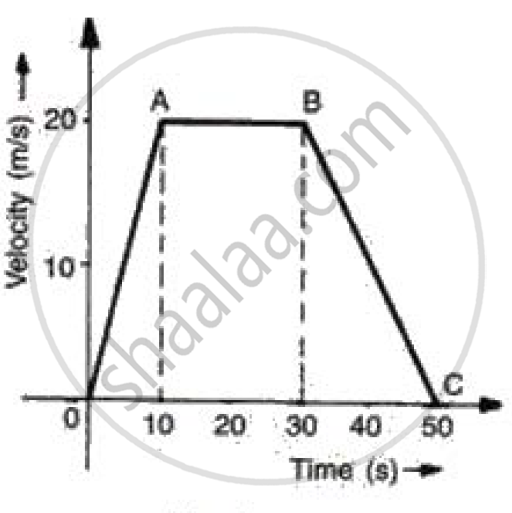
The graph shows how the velocity of a scooter varies with time in 50 s.
Work out: Deceleration
The rate of change of velocity is ______.
A bus can accelerate with an acceleration of 1 m/s2 . Find the minimum time for the bus to attain the speed of 100 km/s from 50 km /s.
The Unit of acceleration is ______.
When a body starts from rest, the acceleration of the body after 2 seconds in ______ of its displacement.
A boy throws a ball up and catches it when the ball falls back. In which part of the motion the ball is accelerating?
If a moving body comes to rest, then its acceleration is ______.
Assertion: A positive acceleration of a body can be associated with the slowing down of the body.
Reason: Acceleration is a vector.
Assertion: When a body is subjected to a uniform acceleration, it is always moving in a straight line.
Reason: Motion may be straight-line motion or circular motion.
What is the difference between uniform acceleration and non–uniform acceleration?
