Advertisements
Advertisements
प्रश्न
A car starts from rest and it is travelling with a velocity of 20 m/s in 10 s. What is its acceleration?
Advertisements
उत्तर
Given :
Initial velocity of the car (u) = 0 m/s
Final velocity of the car (v) = 20 m/s
time taken = 10s
Acceleration = ?
Formula:
Acceleration = \(\frac {20– 0}{10}\) = \(\frac {20}{10}\)
Acceleration of the car = 2 m/s2
APPEARS IN
संबंधित प्रश्न
What is meant by the term retardation? Name its S.I. unit.
The unit of retardation is ____________
The velocity-time graph for a uniformly retarded body is a straight line inclined to the time axis with an obtuse angle. How is retardation calculated from the velocity-time graph?
A car travels with uniform velocity of 25 m s-1 for 5 s. The brakes are then applied and the car is uniformly retarded and comes to rest in further 10 s. Find:
- The distance which the car travels before the brakes are applied,
- Retardation and
- The distance travelled by car after applying the brakes.
State its value in C.G.S. as well as in S.I. system.
Give an example of an accelerated body, moving with a uniform speed.
From the diagram given below, calculate acceleration.
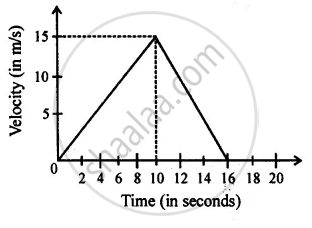
Define acceleration.
Write the SI unit of retardation.
A car traveling at 60 km/h, stops on applying brakes in 10 seconds. What is its acceleration?
The distance covered by a body is directly proportional to the square of the time elapsed. What can you say about its acceleration?
Interpret the following graph: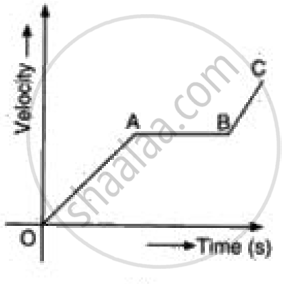
A body has an acceleration of -3.5 ms-2. What is its retardation?
A car accelerates uniformly from a velocity of 18 km/h to 36 km/h in 15 min. What is its acceleration?
The graph shows how the velocity of a scooter varies with time in 50 s.
Work out: Acceleration.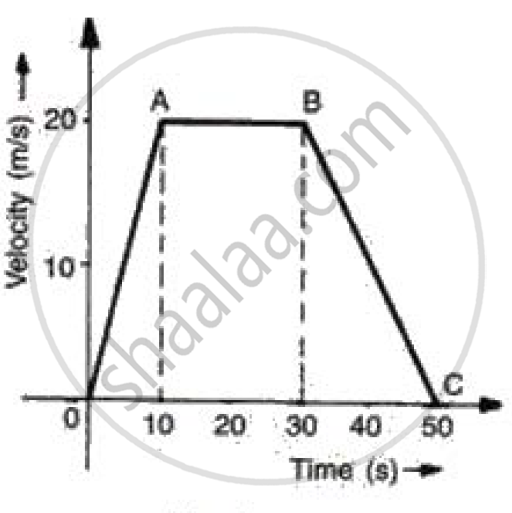
Negative acceleration is called ______.
If the velocity of a body does not change, then its acceleration is ______.
When an object undergoes acceleration ______.
Assertion: A negative acceleration of a body can be associated with speeding up of the body.
Reason: Increase in the speed of a moving body is independent of its direction of motion.
