Advertisements
Advertisements
Question
A toy car initially moving with uniform velocity of 18 km h-1 comes to a stop in 2 s. Find the retardation of the car in S.I. units.
Advertisements
Solution
initial velocity (u) = 18 km/h-1
final velocity (v) = 0 km/h
time (t) = 2 s
acceleration/retardation (a) = ?
To convert initial velocity u to m s-1
18 km/h-1 = `(18 " km")/(1 " h")`
= `(18 xx 1000 " m")/(60 xx 60 " s")`
⇒ 18 km/h-1 = `(18 xx 10 " m")/(6 xx 6 " s")`
⇒ 18 km/h-1 = 5 m s-1
Acceleration (a) = `("Final Velocity "("v") - "Initial Velocity "("u"))/("time "("t"))`
a = `(0 - 5)/2` m s-2
a = `-(5 "ms"^-1)/"2s"`
a = -2.5 m s-2
Hence, acceleration of the body is -2.5 m s-2. Negative sign shows that the velocity decreases with time, so retardation is 2.5 m s-2.
APPEARS IN
RELATED QUESTIONS
Draw a graph for acceleration against time for a uniformly accelerated motion. How can it be used to find the change in speed in a certain interval of time?
Figure given below shows a velocity-time graph for a car starting from rest. The graph has three parts AB, BC and CD.
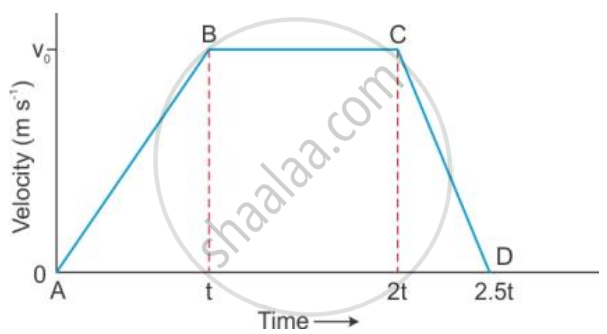
Which part of graph shows motion with uniform
(a) velocity (b) acceleration (c) retardation ?
A car travels with uniform velocity of 25 m s-1 for 5 s. The brakes are then applied and the car is uniformly retarded and comes to rest in further 10 s. Find:
- The distance which the car travels before the brakes are applied,
- Retardation and
- The distance travelled by car after applying the brakes.
Write the SI unit of acceleration and retardation.
State if the following situation is possible:
A body moving with a constant velocity in an accelerated motion.
A body has an acceleration of -3.5 ms-2. What is its retardation?
Convert the following acceleration:
1/36 m/s2 into km/h2
A car accelerates to a velocity of 30 m/s in 10 s and then decelerates for 20 s so that it stops. Draw a velocity-time graph to represent the motion and find:
Distance travelled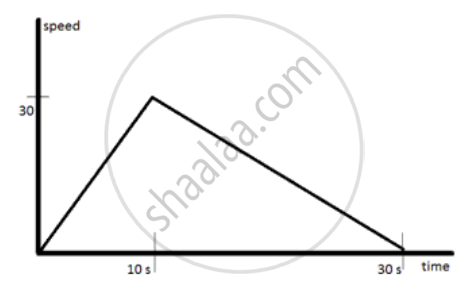
Negative acceleration is called ______.
The Unit of acceleration is ______.
