Advertisements
Advertisements
Question
Draw velocity – time graph for the following situation:
When a body is moving with variable velocity, but uniform acceleration.
Advertisements
Solution
Following is the velocity-time graph:
When a body is moving with variable velocity, but uniform acceleration: Then velocity-time graph OA is a straight line inclined to the time axis.

APPEARS IN
RELATED QUESTIONS
What does the slope of a displacement-time graph represent?
What does the slope of velocity-time graph represent?
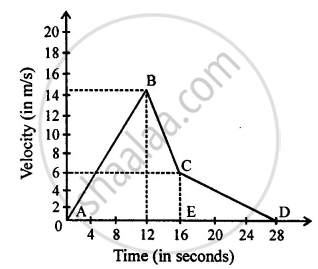
From the velocity – time graph given below, calculate Average velocity in region CED.
What can you conclude if the speed-time graph of a body is a straight line sloping upwards and not passing through the origin?
Draw the following graph:
Speed versus time for a non-uniform acceleration.
What does the slope of speed-time graph indicate?
What can you say about the nature of motion of a body of its displacement-time graph is:
A straight line parallel to line axis?
What can you say about the motion of a body if:
Its time-velocity graph is a straight line
Draw distance-time graph to show:
Increasing velocity
State whether true or false. If false, correct the statement.
If the velocity – time graph of a particle is a straight line inclined to X-axis then its displacement – time graph will be a straight line.
