Advertisements
Advertisements
प्रश्न
Multiple choice Question. Select the correct option.
At the maximum height, a body thrown vertically upwards has :
पर्याय
velocity not zero but acceleration zero.
acceleration not zero but velocity zero.
both acceleration and velocity are zero.
both acceleration and velocity are not zero.
Advertisements
उत्तर
acceleration not zero but velocity zero.
APPEARS IN
संबंधित प्रश्न
When will you say a body is at non-uniform acceleration?
Which of the two can be zero under certain conditions : average speed of a moving body or average velocity of a moving body ?
Define velocity. What is the SI unit of velocity ?
Differentiate between uniform acceleration and variable acceleration.
If a stone and a pencil are dropped simultaneously in vacuum from the top of a tower, then which of the two will reach the ground first? Give reason.
Multiple choice Question. Select the correct option.
The speed of a car reduces from 15 m/s to 5 m/s over a displacement of 10 m. The uniform acceleration of the car is :
How can you find the following?
Velocity from acceleration – time graph.
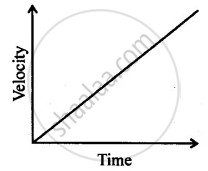
Can you suggest a real-life example about the motion of a body from the following velocity – time graph?
Area under a v – t graph represents a physical quantity which has the unit
An object starting from rest travels 20 m in the first 2 s and 160 m in the next 4 s. What will be the velocity after 7 s from the start?
