Advertisements
Advertisements
प्रश्न
An object starting from rest travels 20 m in the first 2 s and 160 m in the next 4 s. What will be the velocity after 7 s from the start?
Advertisements
उत्तर
For first 2 s motion of object,
u = 0, f = 2 s, s = 20 m
Using s = `"ut" + 1/2 "at"^2`
we got 20 = `0 + 1/2 "a" xx 2^2`
or a = 10 ms−2
Velocity attained by object at the end of 2s
v = u + at
= 0 + 10 × 2
= 20 ms−1
For next 4s, journey of object,
t' = 4s, u' = 20 ms−1, s' = 160 m
∴ s' = `"u'""t'" + 1/2 "a'""t'"^2`
⇒ 160 = `20 xx 4 + 1/2 xx "a'" xx 4^2`
or 8a' = 80 or a' = 10 ms−2
It implies that acceleration is uniform throughout the journey.
∴ velocity after 7s from start, v = u + at
= 0 + 10 × 7
= 70 ms−1
APPEARS IN
संबंधित प्रश्न
When will you say a body is at non-uniform acceleration?
A cheetah starts from, rest, and accelerates at 2 m/s2 for 10 seconds. Calculate :
(a) the final velocity
(b) the distance travelled.
Explain the meaning of the following equation of motion :v = u + at, where symbols have their usual meanings.
Derive the formula : v = u + at, where the symbols have usual meanings.
A car acquire a velocity of 72 km per hour in 10 second starting from rest. Find
(1) the acceleration,
(2) the average velocity, and
(3) the distance travelled in this time.
When a car driver travelling at a speed of 10 m/s applies brakes and brings the car to rest in 20 s, then retardation will be :
The figure shows the displacement - time graph for four bodies A, B C and D. In each case state what information do you get about the acceleration (zero, positive or negative).
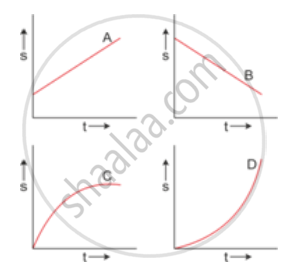
When is the positive acceleration?
A stone thrown vertically upwards takes 3 s to attain maximum height. Calculate
- initial velocity of the stone
- maximum height attained by the stone. (Take g = 9.8 ms−2)
How will the equations of motion for an object moving with a uniform velocity change?
