Advertisements
Advertisements
प्रश्न
Distinguish between acceleration and retardation.
Advertisements
उत्तर
Acceleration is the increase in velocity per second, while retardation is the decrease in velocity per second. Thus, retardation is negative acceleration. In general, acceleration is taken positive, while retardation is taken negative.
APPEARS IN
संबंधित प्रश्न
Define acceleration. State its unit.
Give one example of the following motion:
Uniform retardation
The velocity-time graph for a uniformly retarded body is a straight line inclined to the time axis with an obtuse angle. How is retardation calculated from the velocity-time graph?
Figure given below shows a velocity-time graph for a car starting from rest. The graph has three parts AB, BC and CD.
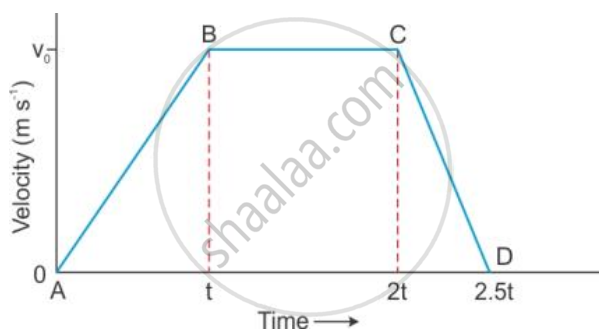
(a) Is the magnitude of acceleration higher or lower than that of retardation ? Give a reason .
(b) Compare the magnitude of acceleration and retardation .
A train starts from rest and accelerates uniformly at a rate of 2 m s−2 for 10 s. It then maintains a constant speed for 200 s. The brakes are then applied and the train is uniformly retarded and comes to rest in 50 s. Find
- The maximum velocity reached,
- The retardation in the last 50 s,
- The total distance travelled,
- The average velocity of the train.
If a body is moving with a constant velocity its acceleration is ______.
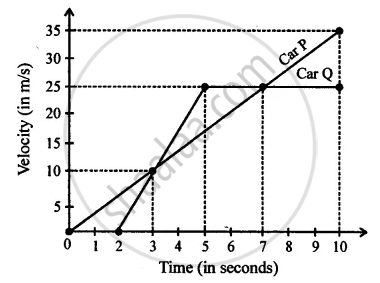
Diagram is given below shows velocity – time graph of car P and Q, starting from the same place and in the same direction. Calculate the Acceleration of car P.
The acceleration of a body is 8.5 ms-2. What does this statement mean?
Distinguish between uniformly and non-uniformly accelerated motions.
A car is moving with a speed of 50 km/h. One second later, its speed is 55 km/h. What is its acceleration?
