Advertisements
Advertisements
प्रश्न
A train starts from rest and accelerates uniformly at a rate of 2 m s−2 for 10 s. It then maintains a constant speed for 200 s. The brakes are then applied and the train is uniformly retarded and comes to rest in 50 s. Find
- The maximum velocity reached,
- The retardation in the last 50 s,
- The total distance travelled,
- The average velocity of the train.
Advertisements
उत्तर
(i) For the first 10 s, initial velocity u = 0
Acceleration a = 2 m/s2
Time taken t = 10 s
Let v be the maximum velocity reached.
Using the first equation of motion
v = u + at
We get
V = (0) + (2) (10)
= 20 m/s−1
(ii) For the last 50 s:
Final velocity = 0 m/s,
Initial velocity = 20 m/s.
`"Acceleration" = ("Final velocity" - "Initial velocity")/"time"`
= `(0 - 20)/50`
= −0.4 m/s2
Retardation = 0.4 m/s−2
(iii) Total distance travelled = Distance travelled in the first 10 s + Distance travelled in 200 s + Distance travelled in last 50 s
Distance travelled in first 10 s (s1) = `ut + (1/2) at^2`
S1 = `(0) + (1/2) (2 xx 10^2)`
S1 = 100 m
Distance travelled in 200 s (s2) = speed × time
S2 = (20) (200) = 4000 m
Distance travelled in last 50 s (s3) = ut + (1/2) at2
Here, u = 20 m/s, t = 50 s and a = −0.4 m/s2
S3 = `(20 xx 50) + (1/2) (-0.4 xx 50^2)`
S3 = 1000 − 500
S3 = 500 m
Therefore, total distance travelled = S1 + S2 + S3
= 100 + 4000 + 500
= 4600 m
(iv) `"Average velocity" = "Total distance travelled"/"total time taken"`
= (4600/260) m/s
= 17.69 m/s−1
APPEARS IN
संबंधित प्रश्न
If a body is moving with a constant velocity its acceleration is ______.
Diagram is given below shows velocity – time graph of car P and Q, starting from the same place and in the same direction. Calculate the Acceleration of car Q between 2 s – 5 s.
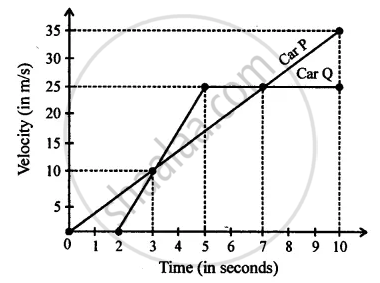
A motor bike running at 90 kmh−1 is slowed down to 18 kmh−1 in 2.5 s. Calculate
- acceleration
- distance covered during slow down.
A car traveling at 60 km/h, stops on applying brakes in 10 seconds. What is its acceleration?
Sketch the shape of the velocity-time graph for a body moving with:
Uniform acceleration.
The slope of a velocity-time graph gives ______.
The acceleration of the body that moves with a uniform velocity will be ______.
If a moving body comes to rest, then its acceleration is ______.
Assertion: Position-time graph of a stationary object is a straight line parallel to the time axis.
Reason: For a stationary object, the position does not change with time.
When a body is said to be in
- uniform acceleration
- non–uniform acceleration?
