Advertisements
Advertisements
प्रश्न
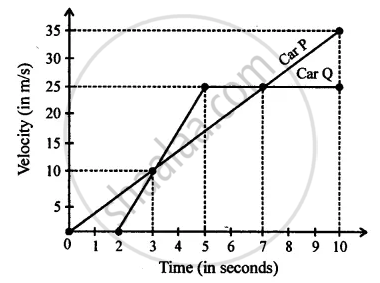
Diagram is given below shows velocity – time graph of car P and Q, starting from the same place and in the same direction. Calculate the Acceleration of car Q between 2 s – 5 s.
Advertisements
उत्तर

Acceleration of car Q between 2 s − 5 s = +Slope of v-t graph (CD) for car Q
= `"DE"/"CE"=25/(5-2)=25/3` = 8.33 ms−2
APPEARS IN
संबंधित प्रश्न
Define the term acceleration due to gravity. State its average value.
The change in velocity of a motorbike is 54 kmh−1 in one minute. Calculate its acceleration in (a) ms−2 (b) kmh−2.
What is the SI unit of acceleration?
The acceleration of a body is 8.5 ms-2. What does this statement mean?
Write the SI unit of acceleration and retardation.
The speed of a car increases from 10 km/h to 64 km/h in 10 seconds. What will be its acceleration?
A car accelerates to a velocity of 30 m/s in 10 s and then decelerates for 20 s so that it stops. Draw a velocity-time graph to represent the motion and find:
The Deceleration.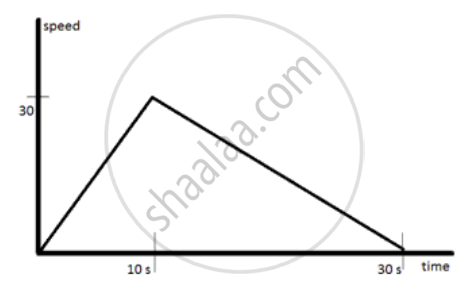
The acceleration of the body that moves with a uniform velocity will be ______.
What is meant by negative acceleration?
Assertion: A positive acceleration of a body can be associated with the slowing down of the body.
Reason: Acceleration is a vector.
