Advertisements
Advertisements
प्रश्न
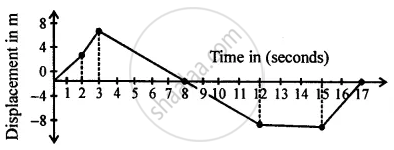
From the displacement – time graph shown given below calculate:
- Average velocity in the first three seconds.
- Displacement from the initial position at the end of 13 s.
- Time after which the body is at the initial position,
- Average velocity after 8 s.
Advertisements
उत्तर
(i) In first three seconds
Total displacement = 8m
Total time = 3 s
Average velocity = Total displacement/Total time = 8/3
= 2.67 ms−1
(ii) Displacement from the initial position at the end of 13s = −8m.
(iii) Body is at the initial position after 8s and 17s.
(iv) Average velocity after 8s is zero because, after 8s, displacement is zero.
APPEARS IN
संबंधित प्रश्न
An ant travels a distance of 8 cm from P to Q and then moves a distance of 6 cm at right angles to PQ. Find its resultant displacement.
A body travels a distance of 3 km towards East, then 4 km towards North and finally 9 km towards East.
What is the resultant displacement ?
Copy the following table and fill in the blank spaces.
| Quantity | S.I. Unit | Scalar or Vector |
| Displacement | ___________ | ___________ |
Under what condition is the displacement of a body equal to the distance traveled by it?
A satellite makes a complete round along its circular orbit. What is its displacement?
Name the physical quantity associated with the rate of change of displacement with time.
An object covers a distance of S meters in t seconds as follows :
| S (meters) | 0 | 8 | 20 | 20 | 16 | 10 | 0 |
| t (Seconds) | 80 | 2 | 5 | 10 | 12 | 15 | 10 |
Plot a graph, taking t on X-axis and S on Y-axis. Determine the velocity of the object at time
(i) 6 s, and
(ii) 14 s.
Distance is a ______ quantity.
Distance travelled by a freely falling body is proportional to ______.
If the displacement-time graph of a particle is parallel to the time axis, the velocity of the particle is ______.
