Advertisements
Advertisements
प्रश्न
How does the slope of a speed-time graph give the acceleration of a body moving along a straight line?
Advertisements
उत्तर
Slope of a graph is given as rate of change of y coordinates to the x coordinate. In speed time graph speed is on the y axis and time is on the x axis. And we define acceleration as rate of change of speed with respect to time. So slope of a speed time graph gives acceleration.
APPEARS IN
संबंधित प्रश्न
The velocity-time graph for part of a train journey is a horizontal straight line. What does this tell you about the trains velocity.
Multiple choice Question. Select the correct option.
The distance covered in the adjoining velocity-time graph is :
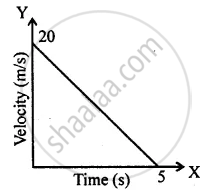
Diagram shows a velocity – time graph for a car starting from rest. The graph has three sections AB, BC and CD.
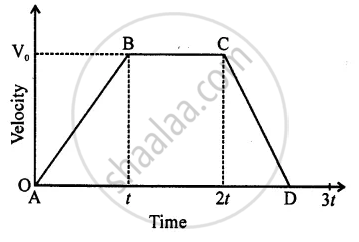
From a study of this graph, state how the distance travelled in any section is determined.
From the velocity – time graph given below, calculate acceleration in the region AB.
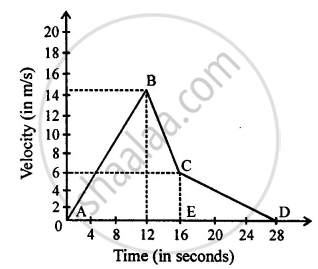
The area of the right triangle under a speed-time graph is 500 m, in a time interval of 20 s. What is the speed of the body? Is the motion uniform or non-uniform?
Which of the following graphs represents a motion with negative acceleration?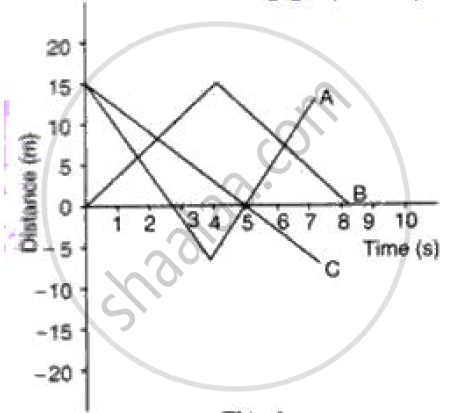
What can you say about the nature of motion of a body of its displacement-time graph is:
A straight line inclined to the time axis with an acute angle?
Draw velocity-time graph to show:
Acceleration
Write a sentence to explain the shape of graph.
Figure shows the velocity-time graphs for two objects A and B moving in same direction . Which object has the greater a cceleration?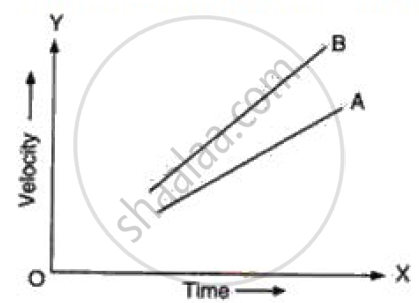
The given graph shows the variation of velocity (v) with position (x) for a particle moving along a straight line
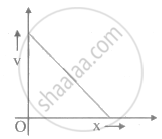
Which of the following graph shows the variation of acceleration (a) with position (x)?
