Advertisements
Advertisements
प्रश्न
The velocity-time graph for part of a train journey is a horizontal straight line. What does this tell you about its acceleration ?
Advertisements
उत्तर
There is no acceleration as the object is moving with uniform velocity.
APPEARS IN
संबंधित प्रश्न
What type of motion is represented by the following graph ?
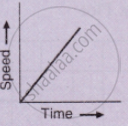
What type of motion is represented by the following graph ?
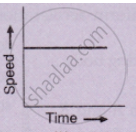
The area under a speed-time graph in a given intervals gives the total distance covered by a body irrespective of its motion being uniform or non-uniform.
What can you conclude if the speed-time graph of a body is a curve moving upwards starting from the origin?
What can you conclude if the speed-time graph of a body is a straight line sloping upwards and not passing through the origin?
Draw the following graph:
Speed versus time for a stepped motion
Interpret the following graph: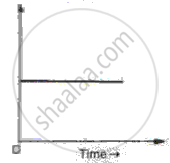
Draw velocity-time graph to show:
Acceleration
Write a sentence to explain the shape of graph.
Derive the equation
S = ut+ `1/2` at2
Using a speed- time graph
An object is moving in a positive direction with positive acceleration. The velocity-time graph with constant acceleration which represents the above situation is:
