Advertisements
Advertisements
प्रश्न
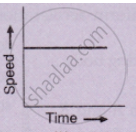
For uniform motion _________
पर्याय
The distance-time graph is a straight line parallel to the time axis.
The speed-time graph is a straight line inclined to the time axis.
The speed-time graph is a straight line parallel to the time axis.
The acceleration-time graph is a straight line parallel to the time axis.
Advertisements
उत्तर
For uniform motion The speed-time graph is a straight line parallel to the time axis.
APPEARS IN
संबंधित प्रश्न
What can you say about the motion of a body if its speed-time graph is a straight line parallel to the time axis ?
The velocity-time graph for part of a train journey is a horizontal straight line. What does this tell you about the trains velocity.
What type of motion is represented by the following graph ?
A car of mass 1000 kg is moving with a velocity of 10 m s−1. If the velocity-time graph for this car is a horizontal line parallel to the time axis, then the velocity of car at the end of 25 s will be :
Multiple choice Question. Select the correct option.
The slope of displacement – time graph represents.
How will you use a speed-time graph to find whether the acceleration of the body is uniform or not?
The graph of one quantity versus another result in a straight line. How are the quantities related to each other?
Draw the speed-time graph of a body when its initial speed is not zero and the speed increases uniformly with time.
What can you conclude if the speed-time graph of a body is a curve moving upwards starting from the origin?
Draw the following graph:
Speed versus time for a non-uniform acceleration.
