Advertisements
Advertisements
Question
The graph shows how the velocity of a scooter varies with time in 50 s.
Work out: The distance traveled in 10 s, 20 s, and 50 s.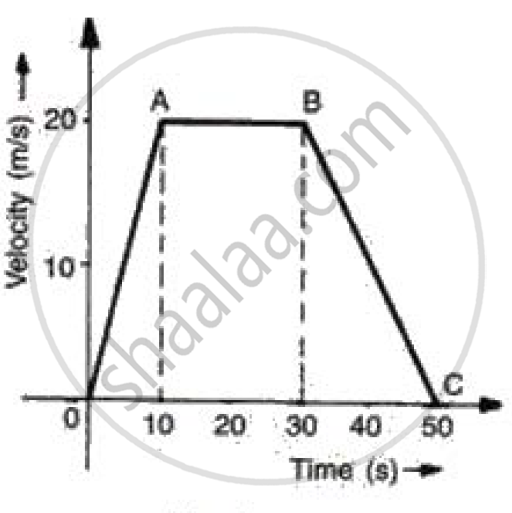
Advertisements
Solution

The distance travelled in 10 sec is S1 = `1/2`x20 x10 = 100 m
Distance travelled in 10s to 30s is s2 = 20 x (30 - 10) = 20 x 20 = 400 m Distance travelled in 30 s to 5os is S3 = `1/2` x20 x(50 - 30) = 200m.
Total distance covered by scooter is = 100 m + 400m + 200m =700m.
APPEARS IN
RELATED QUESTIONS
A boy walks from his classroom to the bookshop along a straight corridor towards North. He covers a distance of 20 m in 25 seconds to reach the bookshop. After buying a book, he travels the same distance in the same time to reach back in the classroom. Find (a) average speed, and (b) average velocity, of the boy.
Is displacement a scalar quantity?
Clarify the difference.
Distance and displacement
A body when projected up with an initial velocity u goes to a maximum height h in time t and then comes back at the point of projection. The correct statement is ______________
Figure given below shows a velocity-time graph for a car starting from rest. The graph has three parts AB, BC and CD.
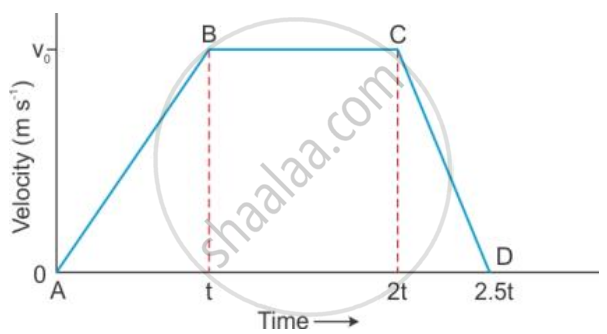
State how is the distance travelled in any part determined from this graph .
Draw displacement – time graph for the following situation:
When a body is moving with uniform velocity.
Ashok starts from his house and travels 3 km to reach his school. On finding the school gates closed, he returns to his house. What is?
The distance traveled by Ashok.
A car travels at a uniform speed of 42 km/h. In 10 minutes, how much distance would it cover?
Exercise Problems.
An athlete completes one round of a circular track of diameter 200 m in 40 s. What will be the distance covered and the displacement at the end of 2 m and 20 s?
The rate of change of displacement ______.
