Advertisements
Advertisements
प्रश्न
The table below shows the distance travelled by two vehicles A and B during each second:
| Time (s) | 0 | 1 | 2 | 3 | 4 | 5 | 6 | 7 |
| Distance travelled by A (m) | 0 | 20 | 80 | 180 | 240 | 300 | 360 | 420 |
| Distance travelled by B (m) | 0 | 10 | 40 | 90 | 160 | 250 | 360 | 490 |
Give the value of the velocity at which they are meeting
Advertisements
उत्तर
Velocity of both the vehicles is 60 m/s when they meet.
APPEARS IN
संबंधित प्रश्न
A body is moving along a circular path of radius R. What will be the distance travelled and displacement of the body when it completes half a revolution ?
What can you say about the nature of motion of a body if its displacement-time graph is A straight line inclined to the time axis with an obtuse angle?
A car starting from rest accelerates uniformly to acquire a speed 20 km h-1 in 30 min. The distance travelled by a car in this time interval will be _____________
Copy the following table and fill in the blank spaces.
| Quantity | S.I. Unit | Scalar or Vector |
| Displacement | ___________ | ___________ |
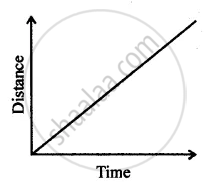
Can you suggest the kind of motion of a body from the following distance – time graph?
Show the difference between distance and displacement with the help of a diagram.
Give the name of the physical quantity that corresponds to the rate of change of displacement.
A particle moves along a circular path. How many times does it change its direction in two complete rounds?
The shortest distance between two places is ______.
A man leaves his house at 6.30 a.m. for a morning walk and returns back at 7.30 a.m. after covering 4 km. The Displacement covered by him is ______.
