Advertisements
Advertisements
प्रश्न
Assertion: Displacement of a body may be zero when distance travelled by it is not zero.
Reason: The displacement is the shortest distance between initial and final position.
पर्याय
If both assertion and reason are true and reason is the correct explanation of assertion.
If both assertion and reason are true but reason is not the correct explanation of assertion.
If assertion is true but reason is false.
If assertion is false but reason is true.
Advertisements
उत्तर
If both assertion and reason are true and reason is the correct explanation of assertion.
APPEARS IN
संबंधित प्रश्न
Fill in the following blank with suitable word :
Displacement is a…………………… quantity whereas distance is a………………………….
Figure given below shows a velocity-time graph for a car starting from rest. The graph has three parts AB, BC and CD.
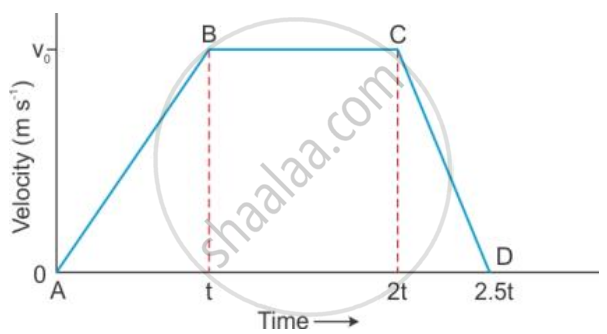
State how is the distance travelled in any part determined from this graph .
Define Displacement.
Can a body have negative displacement?
Is distance covered during nth second more than the distance covered in n seconds?
A particle moves along a circular path. How many times does it change its direction in two complete rounds?
Match the following.
| 1. | Displacement | Knot |
| 2. | Light travelling through vacuum | Geometric centre |
| 3. | Speed of ship | Metre |
| 4. | Centre of gravity of geometrical shaped objects | Larger base area |
| 5. | Stability | Uniform velocity |
Give one example where the displacement is zero but the distance travelled is not zero.
A scalar quantity has ______.
Choose the correct option.
