Advertisements
Advertisements
प्रश्न
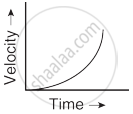
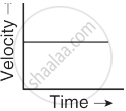
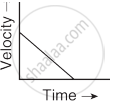
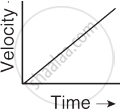
Match the Following.
| Sr. No. | List I | List II | |
| 1. | Motion of a body covering equal distances in equal interval of time | A. | ![]() |
| 2. | Motion with non uniform acceleration | B. | ![]() |
| 3. | Constant retardation | C. | ![]() |
| 4. | Uniform acceleration | D. | ![]() |
Advertisements
उत्तर
| Sr. No. | List I | List II | |
| 1. | Motion of a body covering equal distances in equal interval of time | D. | ![]() |
| 2. | Motion with non uniform acceleration | C. | ![]() |
| 3. | Constant retardation | A. | ![]() |
| 4. | Uniform acceleration | B. | ![]() |
APPEARS IN
संबंधित प्रश्न
An object has moved through a distance. Can it have zero displacement? If yes, support your answer with an example.
When a car runs on a circular track with a uniform speed, its velocity is said to be changing. This is because ______.
The area under a speed-time graph represents a physical quantity which has the unit of :
Write the similarities and differences between the motion of a bicycle and a ceiling fan that has been switched on.
The movement of a body about its own axis is ______.
Correct the following.
1 m = 1000 cm
Motion of an object or a part of it around a fixed point is known as ______ motion.
Rest and motion of the body are ______.
If a body does not change its position, then it is said to be at ______.
Time is a vector quantity.