Advertisements
Advertisements
Question
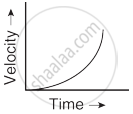
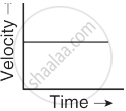
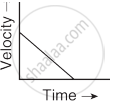
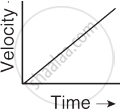
Match the Following.
| Sr. No. | List I | List II | |
| 1. | Motion of a body covering equal distances in equal interval of time | A. | ![]() |
| 2. | Motion with non uniform acceleration | B. | ![]() |
| 3. | Constant retardation | C. | ![]() |
| 4. | Uniform acceleration | D. | ![]() |
Advertisements
Solution
| Sr. No. | List I | List II | |
| 1. | Motion of a body covering equal distances in equal interval of time | D. | ![]() |
| 2. | Motion with non uniform acceleration | C. | ![]() |
| 3. | Constant retardation | A. | ![]() |
| 4. | Uniform acceleration | B. | ![]() |
APPEARS IN
RELATED QUESTIONS
Name the type of motion being performed by Vehicle on a straight road.
An object has moved through a distance. Can it have zero displacement? If yes, support your answer with an example.
The area under a speed-time graph represents a physical quantity which has the unit of :
A motorcycle is being driven at a speed of 20 m/s when brakes are applied to bring it to rest in five seconds. The deceleration produced in this case will be :
The unit of ‘g’ is m s-2. It can be also expressed as
Write the similarities and differences between the motion of a bicycle and a ceiling fan that has been switched on.
Motion is of ______ types.
A particle is moving in a circular path of radius r. The displacement after half a circle would be:
A body repeating its motion after certain interval of time is in ______ motion.
If a body does not change its position, then it is said to be at ______.