Advertisements
Advertisements
प्रश्न
A motorcyclist drives from A to B with a uniform speed of 30 km h–1 and returns back with a speed of 20 km h–1. Find its average speed.
Advertisements
उत्तर
Let the distance between A and B be S km.
Time taken in going from A to B = `"s"/30 "h"`
Time taken in going from B to A = `"s"/20 "h"`
Average speed of motorcyclist = `"total distance covered"/"total time taken"`
= `("S km" + "S km")/("S"/30"h" + "S"/20"h")`
= `2/(1/30 + 1/20) "km h^-1"`
= `2/(1/12) "km h"^-1`
= 24 km h−1
APPEARS IN
संबंधित प्रश्न
Joseph jogs from one end A to the other end B of a straight 300 m road in 2 minutes 30 seconds and then turns around and jogs 100 m back to point C in another 1 minute. What are Joseph’s average speeds and velocities in jogging?
- from A to B and
- from A to C?
Name the physical quantity obtained by dividing ‘Distance travelled’ by ‘Time taken’ to travel that distance.
Fill in the following blank with suitable word:
The physical quantity which gives both, the speed and direction of motion of a body is called its……………
Arrange the following speed in increasing order (keeping the least speed first
A scooter moving with a speed of 30 km/h.
A car is moving along a straight road at a steady speed. It travels 150 m in 5 seconds:
What is its average speed ?
A car is moving along a straight road at a steady speed. It travels 150 m in 5 seconds:
How far does it travel in 6 seconds ?
A car travels 100 km at a speed of 60 km/h and returns with a speed of 40 km/h. Calculate the average speed for the whole journey.
A car moving on a straight path covers a distance of 1 km due east in 100 s. What is velocity of the car?
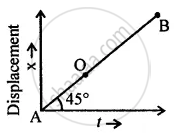
Write down the type of motion of a body along with the A – O – B of the following distance – time graph.
Derive th e equation of motion.
S = ut+ `1/2` at2,
Where the symbols have their usual meanings
