Advertisements
Advertisements
Question
Fill in the following blanks with suitable words :
Forces in a Newton’s third law pair have equal _____________ but act in opposite _____________.
Advertisements
Solution
Forces in a Newton’s third law pair have equal magnitude but act in opposite directions.
APPEARS IN
RELATED QUESTIONS
If action is always equal to the reaction, explain how a horse can pull a cart.
Why does a gunman get a jerk on firing a bullet ?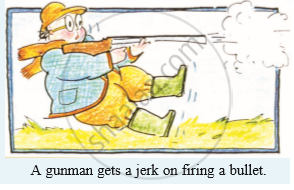
Explain why, a runner presses the ground with his feet before he starts his run.
Name the law involved in the following situation :
when person A standing on roller skates pushes another person B (also standing on roller skates) and makes him move to the right side, then the person A himself gets moved to the left side by an equal distance.
According to the third law of motion, action and reaction :
Give scientific reasons.
It is easier to stop a tennis ball as compared to a cricket ball when both are travelling with the same velocity.
Complete a sentence and explain it.
The working of a rocket depends on Newton's ______ law of motion.
According to the third law of motion, action and reaction
Why do the action and reaction forces in a pair not cancel each other out?
A book is resting on a table. Which of the following is the correct reaction force to the gravitational pull of the Earth on the book?
