English

According to the Third Law of Motion, Action and Reaction : - Science

Advertisements
Advertisements

Question

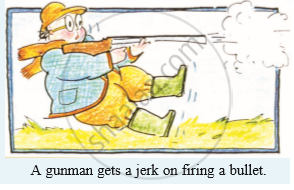
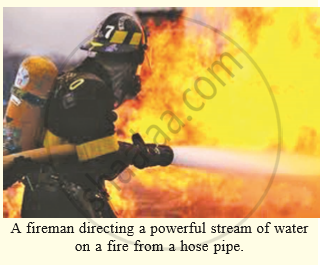
According to the third law of motion, action and reaction :

Options

  • always act on the same body but in opposite directions

  • always act on different bodies in opposite directions

  • have same magnitudes and directions

  • act on either body at normal to each other

MCQ
Advertisements

Solution

always act on different bodies in opposite directions.

shaalaa.com
  Is there an error in this question or solution?
Chapter 2: Force and Laws of Motion - Very Short Answers 2 [Page 76]

APPEARS IN

Lakhmir Singh Physics (Science) [English] Class 9 ICSE
Chapter 2 Force and Laws of Motion
Very Short Answers 2 | Q 44 | Page 76

Video TutorialsVIEW ALL [1]

RELATED QUESTIONS

Using a horizontal force of 200 N, we intend to move a wooden cabinet across a floor at a constant velocity. What is the friction force that will be exerted on the cabinet?


Is the following statement true or false :
A rocket can propel itself in a vacuum.


A girl weighing 25 kg stands on the tloor. She exerts a downward force of 250 N on the floor. What force does the floor exert on her ?


Fill in the following blanks with suitable words :

Forces in a Newton’s third law pair have equal _____________ but act in opposite _____________.


Explain why, a runner presses the ground with his feet before he starts his run.


Draw a diagram to show how a rocket engine provides a force to move the rocket upwards. Label the diagram appropriately.


State Newton’s third law of motion and give two examples to illustrate the law.
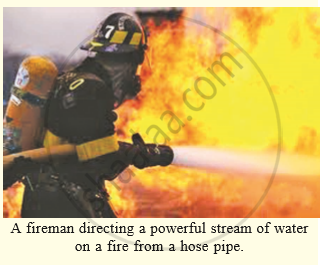

Consider a frame that is made up of two thin massless rods AB and AC as shown in the figure. A vertical force `vec"P"` of magnitude 100 N is applied at point A of the frame.

Suppose the force is `vec"P"` resolved parallel to the arms AB and AC of the frame.

The magnitude of the resolved component along the arm AC is xN.

The value of x, to the nearest integer, is ______.

[Given: sin(35°) = 0.573, cos(35°) = 0.819, sin(110°) = 0.939, cos(110°) = –0.342]


Why do the action and reaction forces in a pair not cancel each other out?


A book is resting on a table. Which of the following is the correct reaction force to the gravitational pull of the Earth on the book?


Share
Notifications

Englishहिंदीमराठी


      Forgot password?
Use app×