Advertisements
Advertisements
प्रश्न
According to the third law of motion, action and reaction :
विकल्प
always act on the same body but in opposite directions
always act on different bodies in opposite directions
have same magnitudes and directions
act on either body at normal to each other
Advertisements
उत्तर
always act on different bodies in opposite directions.
APPEARS IN
संबंधित प्रश्न
Explain, why is it difficult for a fireman to hold a hose, which ejects large amounts of water at a high velocity.
According to the third law of motion, when we push on an object, the object pushes back on us with an equal and opposite force. If the object is a massive truck parked along the roadside, it will probably not move. A student justifies this by answering that the two opposite and equal forces cancel each other. Comment on this logic and explain why the truck does not move.
If action is always equal to reaction, explain why a cart pulled by a horse can be moved.
If a man jumps out from a boat, the boat moves backwards. Why ?
Draw a diagram to show how a rocket engine provides a force to move the rocket upwards. Label the diagram appropriately.
Name the law involved in the following situation :
when person A standing on roller skates pushes another person B (also standing on roller skates) and makes him move to the right side, then the person A himself gets moved to the left side by an equal distance.
“Wearing helmet and fastening the seat belt is highly recommended for safe journey” Justify your answer using Newton’s laws of motion.
Consider a frame that is made up of two thin massless rods AB and AC as shown in the figure. A vertical force `vec"P"` of magnitude 100 N is applied at point A of the frame.
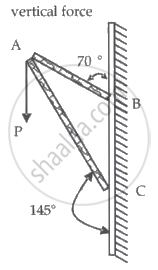
Suppose the force is `vec"P"` resolved parallel to the arms AB and AC of the frame.
The magnitude of the resolved component along the arm AC is xN.
The value of x, to the nearest integer, is ______.
[Given: sin(35°) = 0.573, cos(35°) = 0.819, sin(110°) = 0.939, cos(110°) = –0.342]
Why do the action and reaction forces in a pair not cancel each other out?
In a hose pipe ejecting water, what is the reaction force?
