Advertisements
Advertisements
प्रश्न
Explain, why is it difficult for a fireman to hold a hose, which ejects large amounts of water at a high velocity.
Advertisements
उत्तर
Due to the backward reaction of the water being ejected
When a fireman holds a hose, which is ejecting large amounts of water at a high velocity, then a reaction force is exerted on him by the ejecting water in the backward direction. This is because of Newton’s third law of motion. As a result of the backward force, the stability of the fireman decreases. Hence, it is difficult for him to remain stable while holding the hose.
संबंधित प्रश्न
Using a horizontal force of 200 N, we intend to move a wooden cabinet across a floor at a constant velocity. What is the friction force that will be exerted on the cabinet?
Why does a gunman get a jerk on firing a bullet ?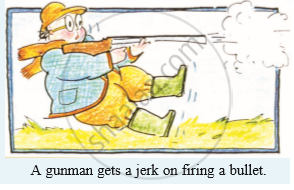
Explain how a rocket works.
Why is it difficult to walk on a slippery road ?
Explain why, when a fireman directs a powerful stream of water on a fire from a hose pipe, the hose pipe tends to go backward.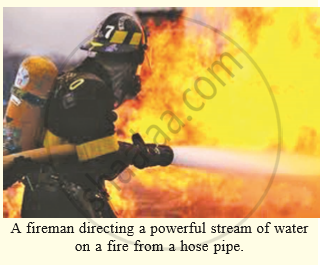
Complete a sentence and explain it.
The working of a rocket depends on Newton's ______ law of motion.
While catching a cricket ball the fielder lowers his hands backwards. Why?
“Wearing helmet and fastening the seat belt is highly recommended for safe journey” Justify your answer using Newton’s laws of motion.
According to the third law of motion, action and reaction
In a hose pipe ejecting water, what is the reaction force?
