Advertisements
Advertisements
प्रश्न
A stone of 1 kg is thrown with a velocity of 20 m s−1 across the frozen surface of a lake and comes to rest after travelling a distance of 50 m. What is the force of friction between the stone and the ice?
Advertisements
उत्तर
Mass of the stone (m) = 1kg
Distance travelled (s) = 50 m
Initial velocity of the stone (u) = 20 m/s
The final velocity of the stone (v) = 0 m/s
From the third equation of motion
v2 - u2 = 2as
02 - (20)2 = 2 × a × 50
02 - (20)2 = 100a
a = `(-400)/100`
a = -4 m s-2
The frictional force between the stone and ice
F = m × a
F = 1 × -4
= -4 N
Therefore, the frictional force between the stone and ice = -4 N
संबंधित प्रश्न
If action is always equal to the reaction, explain how a horse can pull a cart.
What is the force which produces an acceleration of 1 m /s2 in a body of mass 1 kg ?
Why does a gunman get a jerk on firing a bullet ?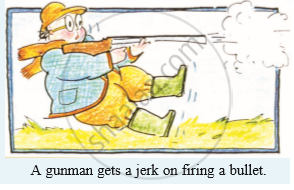
If action is always equal to reaction, explain why a cart pulled by a horse can be moved.
If a man jumps out from a boat, the boat moves backwards. Why ?
Give scientific reasons.
It is easier to stop a tennis ball as compared to a cricket ball when both are travelling with the same velocity.
Consider a frame that is made up of two thin massless rods AB and AC as shown in the figure. A vertical force `vec"P"` of magnitude 100 N is applied at point A of the frame.
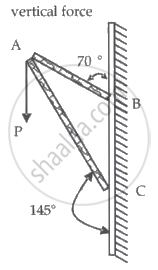
Suppose the force is `vec"P"` resolved parallel to the arms AB and AC of the frame.
The magnitude of the resolved component along the arm AC is xN.
The value of x, to the nearest integer, is ______.
[Given: sin(35°) = 0.573, cos(35°) = 0.819, sin(110°) = 0.939, cos(110°) = –0.342]
Why do the action and reaction forces in a pair not cancel each other out?
In a hose pipe ejecting water, what is the reaction force?
Can action and reaction forces be noncontact forces?
