Advertisements
Advertisements
प्रश्न
Explain how a rocket works.
Advertisements
उत्तर
The hot gases, produced by the rapid burning of the fuel, rush out of a jet at the bottom of the rocket at a very high speed. The equal and opposite reaction force of the downward going gases pushes the rocket upwards. A rocket can propel itself even in vacuum because it does not require air for obtaining uplift or for burning its fuel.
APPEARS IN
संबंधित प्रश्न
Explain, why is it difficult for a fireman to hold a hose, which ejects large amounts of water at a high velocity.
Using a horizontal force of 200 N, we intend to move a wooden cabinet across a floor at a constant velocity. What is the friction force that will be exerted on the cabinet?
A girl weighing 25 kg stands on the tloor. She exerts a downward force of 250 N on the floor. What force does the floor exert on her ?
If action is always equal to reaction, explain why a cart pulled by a horse can be moved.
Do action and reaction act on the same body or different bodies ? How are they related in magnitude and direction ? Are they simultaneous or not ?
State Newton’s third law of motion and give two examples to illustrate the law.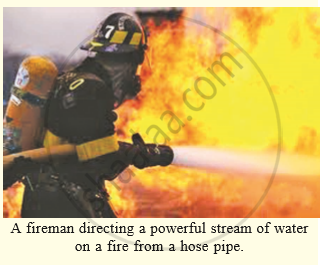
Explain why, when a fireman directs a powerful stream of water on a fire from a hose pipe, the hose pipe tends to go backward.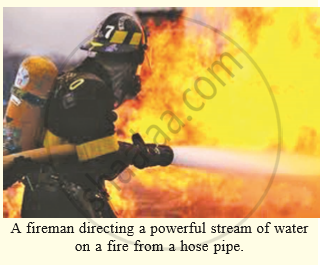
Complete a sentence and explain it.
The working of a rocket depends on Newton's ______ law of motion.
Why do the action and reaction forces in a pair not cancel each other out?
Can action and reaction forces be noncontact forces?
