Advertisements
Advertisements
प्रश्न
According to the third law of motion, when we push on an object, the object pushes back on us with an equal and opposite force. If the object is a massive truck parked along the roadside, it will probably not move. A student justifies this by answering that the two opposite and equal forces cancel each other. Comment on this logic and explain why the truck does not move.
Advertisements
उत्तर
- The truck has a big bulk. As a result, the truck's static friction with the road is extremely high.
- To move the car, one must exert more force than static friction. As a result, when someone pushes the vehicle and it does not move, the imparted force in one direction is balanced by an equivalent amount of frictional force operating in the opposing direction.
- As a result, moving the vehicle requires a significant amount of imbalanced force.
- As a result, the student is correct in claiming that the two opposite and equal concepts cancel each other out.
APPEARS IN
संबंधित प्रश्न
If action is always equal to the reaction, explain how a horse can pull a cart.
If action is always equal to reaction, explain why a cart pulled by a horse can be moved.
If a man jumps out from a boat, the boat moves backwards. Why ?
Why is it difficult to walk on a slippery road ?
Explain why, a runner presses the ground with his feet before he starts his run.
Draw a diagram to show how a rocket engine provides a force to move the rocket upwards. Label the diagram appropriately.
State Newton’s third law of motion and give two examples to illustrate the law.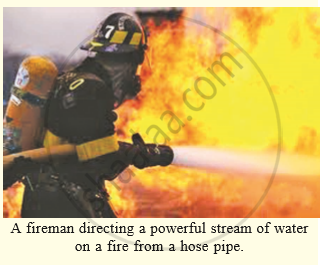
Explain why, when a fireman directs a powerful stream of water on a fire from a hose pipe, the hose pipe tends to go backward.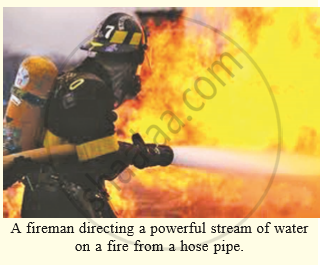
According to the third law of motion, action and reaction :
According to the third law of motion, action and reaction
