Advertisements
Advertisements
प्रश्न
A stone of 1 kg is thrown with a velocity of 20 m s−1 across the frozen surface of a lake and comes to rest after travelling a distance of 50 m. What is the force of friction between the stone and the ice?
Advertisements
उत्तर
Mass of the stone (m) = 1kg
Distance travelled (s) = 50 m
Initial velocity of the stone (u) = 20 m/s
The final velocity of the stone (v) = 0 m/s
From the third equation of motion
v2 - u2 = 2as
02 - (20)2 = 2 × a × 50
02 - (20)2 = 100a
a = `(-400)/100`
a = -4 m s-2
The frictional force between the stone and ice
F = m × a
F = 1 × -4
= -4 N
Therefore, the frictional force between the stone and ice = -4 N
संबंधित प्रश्न
Is the following statement true or false :
A rocket can propel itself in a vacuum.
A girl weighing 25 kg stands on the tloor. She exerts a downward force of 250 N on the floor. What force does the floor exert on her ?
If a man jumps out from a boat, the boat moves backwards. Why ?
Explain why, a runner presses the ground with his feet before he starts his run.
Name the law involved in the following situation :
when person A standing on roller skates pushes another person B (also standing on roller skates) and makes him move to the right side, then the person A himself gets moved to the left side by an equal distance.
State Newton’s third law of motion and give two examples to illustrate the law.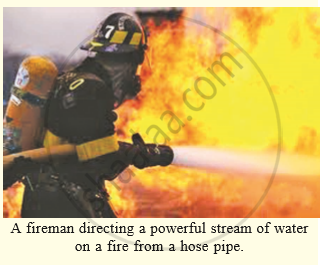
Give a scientific reason.
Even though the magnitudes of action force and reaction forces are equal and their directions are opposite, their effects do not get cancelled.
“Wearing helmet and fastening the seat belt is highly recommended for safe journey” Justify your answer using Newton’s laws of motion.
A book is resting on a table. Which of the following is the correct reaction force to the gravitational pull of the Earth on the book?
What is the main characteristic of action and reaction forces?
