Advertisements
Advertisements
प्रश्न
According to the third law of motion, action and reaction :
पर्याय
always act on the same body but in opposite directions
always act on different bodies in opposite directions
have same magnitudes and directions
act on either body at normal to each other
Advertisements
उत्तर
always act on different bodies in opposite directions.
APPEARS IN
संबंधित प्रश्न
If action is always equal to the reaction, explain how a horse can pull a cart.
Is the following statement true or false :
A rocket can propel itself in a vacuum.
A girl weighing 25 kg stands on the tloor. She exerts a downward force of 250 N on the floor. What force does the floor exert on her ?
Do action and reaction act on the same body or different bodies ? How are they related in magnitude and direction ? Are they simultaneous or not ?
Name the law involved in the following situation :
when person A standing on roller skates pushes another person B (also standing on roller skates) and makes him move to the right side, then the person A himself gets moved to the left side by an equal distance.
State Newton’s third law of motion and give two examples to illustrate the law.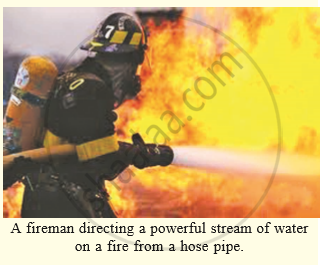
Give scientific reasons.
It is easier to stop a tennis ball as compared to a cricket ball when both are travelling with the same velocity.
According to the third law of motion, action and reaction
In a hose pipe ejecting water, what is the reaction force?
What is the main characteristic of action and reaction forces?
