Advertisements
Advertisements
प्रश्न
A plastic ball and a clay ball of equal masses, travelling in the same direction with equal speeds, strike against a vertical wall. From which ball does the wall receive a greater amount of momentum ?
Advertisements
उत्तर
The wall will receive equal momentum from both the balls because both balls have equal mass and velocity.
APPEARS IN
संबंधित प्रश्न
Two objects, each of mass 1.5 kg are moving in the same straight line but in opposite directions. The velocity of each object is 2.5 m s−1 before the collision during which they stick together. What will be the velocity of the combined object after collision?
A nucleus is at rest in the laboratory frame of reference. Show that if it disintegrates into two smaller nuclei the products must move in opposite directions.
Two billiard balls, each of mass 0.05 kg, moving in opposite directions with speed 6 ms-1collide and rebound with the same speed. What is the impulse imparted to each ball due to the other?
A shell of mass 0.020 kg is fired by a gun of mass 100 kg. If the muzzle speed of the shell is 80 m s–1, what is the recoil speed of the gun?
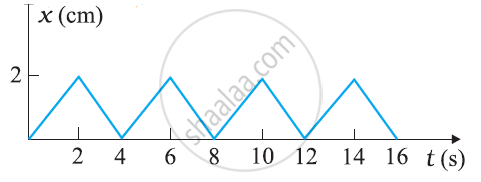
Figure shows the position-time graph of a body of mass 0.04 kg. Suggest a suitable physical context for this motion. What is the time between two consecutive impulses received by the body ? What is the magnitude of each impulse ?
A man throws a ball weighing 500 g vertically upwards with a speed of 10 m/s.
- What will be its initial momentum ?
- What would be its momentum at the highest point of its flight ?
A 150 g ball, travelling at 30 m/s, strikes the palm of a player’s hand and is stopped in 0.05 second. Find the force exerted by the ball on the hand.
An unloaded truck weighing 2000 kg has a maximum acceleration of 0.5 m/s2. What is the maximum acceleration when it is carrying a load of 2000 kg ?
A boy of mass 50 kg running at 5 m/s jumps on to a 20 kg trolley travelling in the same direction at 1.5 m/s. What is their common velocity ?
The rockets work on the principle of conservation of :
