Advertisements
Advertisements
प्रश्न
A 150 g ball, travelling at 30 m/s, strikes the palm of a player’s hand and is stopped in 0.05 second. Find the force exerted by the ball on the hand.
Advertisements
उत्तर
Mass of the ball, m = 150 g = 0.15 kg
Initial velocity of the ball, u = 30 m/s
Initial momentum of the ball, pi = mu = 4.5 kg.m/s
The player’s hand stops the ball in 0.05 s.
Thus, final momentum of the ball is, pf = 0
So, change in momentum of the ball = pf − pi
= 0 − 4.5
= −4.5 kg.m/s
So, rate of change of momentum is = −4.5/0.05 = −90 N
This is the force exerted by the hand on the ball.
So, the force exerted by the ball on the hand is = 90 N
APPEARS IN
संबंधित प्रश्न
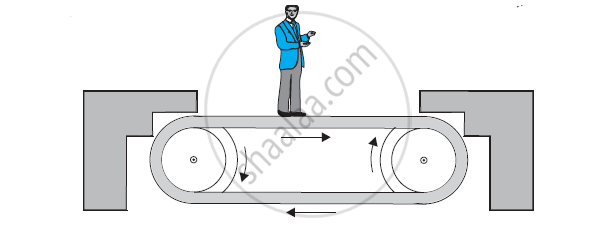
Figure shows a man standing stationary with respect to a horizontal conveyor belt that is accelerating with 1 m s–2. What is the net force on the man? If the coefficient of static friction between the man’s shoes and the belt is 0.2, up to what acceleration of the belt can the man continue to be stationary relative to the belt? (Mass of the man = 65 kg.)
Name the physical quantity which is considered to be a measure of the quantity of motion of a body.
Explain why, it is easier to stop a tennis ball than a cricket ball moving with the same speed.
State the relation between the momentum of a body and the force acting on it.
Fill in the following blanks with suitable words :
In collisions and explosions, the total _____________ remains constant, provided that no external _____________ acts.
A gun of mass 3 kg fires a bullet of mass 30 g. The bullet takes 0.003 s to move through the barrel of the gun and acquires a velocity of 100 m/s. Calculate:
- the velocity with which the gin recoils.
- the force exerted on gunman due to recoil of the gun
Name the law involved in the following situation :
the sum of products of masses and velocities of two moving bodies before and after their collision remains the same.
Why would an aircraft be unable to fly on the moon ?
A man wearing a bullet-proof vest stands still on roller skates. The total mass is 80 kg. A bullet of mass 20 grams is fired at 400 m/s. It is stopped by the vest and falls to the ground. What is then the velocity of the man?
Two billiard balls A and B, each of mass 50 g and moving in opposite directions with speed of 5 ms–1 each, collide and rebound with the same speed. If the collision lasts for 10–3 s, which of the following statements are true?
- The impulse imparted to each ball is 0.25 kg ms–1 and the force on each ball is 250 N.
- The impulse imparted to each ball is 0.25 kg ms–1 and the force exerted on each ball is 25 × 10–5 N.
- The impulse imparted to each ball is 0.5 Ns.
- The impulse and the force on each ball are equal in magnitude and opposite in direction.
