Advertisements
Advertisements
प्रश्न
Explain why, a cricket player moves his hands backwards while catching a fast cricket ball.
Advertisements
उत्तर
By moving the hand backwards, a fielder increases the time of action of the force on his hands. When the time increases, the force reduces and the chances of the fielder getting hurt and dropping the ball decreases.
APPEARS IN
संबंधित प्रश्न
A shell of mass 0.020 kg is fired by a gun of mass 100 kg. If the muzzle speed of the shell is 80 m s–1, what is the recoil speed of the gun?
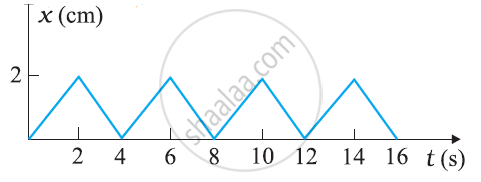
Figure shows the position-time graph of a body of mass 0.04 kg. Suggest a suitable physical context for this motion. What is the time between two consecutive impulses received by the body ? What is the magnitude of each impulse ?
Name the physical quantity whose unit is kg.m/s.
Explain the meaning of the following equation : .
p = m x v
where symbols have their usual meanings.
What is the momentum in kg.m/s of a 10 kg car travelling at (a) 5 m/s (b) 20 cm/s, and (c) 36 km/h ?
Name the principle on which a rocket works.
A gun of mass 3 kg fires a bullet of mass 30 g. The bullet takes 0.003 s to move through the barrel of the gun and acquires a velocity of 100 m/s. Calculate:
- the velocity with which the gin recoils.
- the force exerted on gunman due to recoil of the gun
Why are car seat-belts designed to stretch some what in a collision ?
A girl of mass 50 kg jumps out of a rowing boat of mass 300 kg on to the bank, with a horizontal velocity of 3 m/s. With what velocity does the boat begin to move backwards ?
The rockets work on the principle of conservation of :
