Advertisements
Advertisements
प्रश्न
The rockets work on the principle of conservation of :
विकल्प
mass
energy
momentum
velocity
Advertisements
उत्तर
momentum
The chemicals inside the rocket burn and produce a high-velocity blast of hot gases which move out through the tail nozzle of the rocket. As these gases move in downward direction with tremendous speed, the rocket moves up to balance the momentum of gases.
APPEARS IN
संबंधित प्रश्न
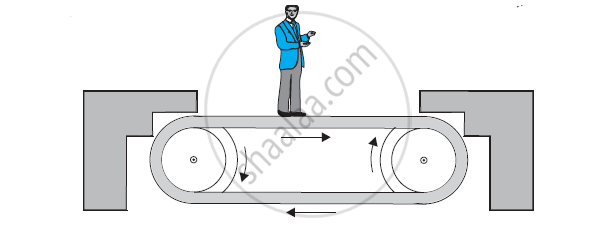
Figure shows a man standing stationary with respect to a horizontal conveyor belt that is accelerating with 1 m s–2. What is the net force on the man? If the coefficient of static friction between the man’s shoes and the belt is 0.2, up to what acceleration of the belt can the man continue to be stationary relative to the belt? (Mass of the man = 65 kg.)
Name the physical quantity which is considered to be a measure of the quantity of motion of a body.
Name the law involved in the following situation :
the sum of products of masses and velocities of two moving bodies before and after their collision remains the same.
A 150 g ball, travelling at 30 m/s, strikes the palm of a player’s hand and is stopped in 0.05 second. Find the force exerted by the ball on the hand.
The troops (soldiers) equipped to be dropped by parachutes from an aircraft are called paratroopers. Why do paratroopers roll on landing ?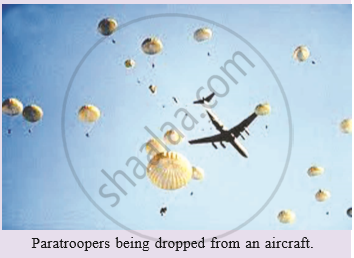
A boy of mass 50 kg running at 5 m/s jumps on to a 20 kg trolley travelling in the same direction at 1.5 m/s. What is their common velocity ?
A ball X of mass 1 kg travelling at 2 m/s has a head-on collision with an identical ball Y at rest. X stops and Y moves off. Calculate the velocity of Y after the collision.
A vessel at rest explodes into three pieces. Two pieces having equal masses fly-off perpendicular to one another with the same velocity 30 meter per second. The third piece has three times mass of each of other piece. The magnitude and direction of the velocity of the third piece will be
A 100 kg gun fires a ball of 1 kg horizontally from a cliff of height 500 m. It falls on the ground at a distance of 400 m from the bottom of the cliff. Find the recoil velocity of the gun. (acceleration due to gravity = 10 ms–2)
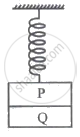
Two blocks P and Q of masses 0.3 kg and 0.4 kg, respectively, are stuck to each other by some weak glue as shown in the figure. They hang together at the end of a spring with a spring constant of k = 200 N/m. The block Q suddenly falls free due to the failure of glue, then the maximum kinetic energy of block P during subsequent motion will be ______ mJ.